Specialist Task Force 294:
Improving the quality of eEurope wideband speech applications by developing a
standardised performance testing and evaluation methodology for background noise
transmission
NEWS:
ETSI
Workshop on Speech and Noise in Wideband Communication
22nd &
23rd May 2007, at ETSI Headquarters in Sophia Antipolis, France
The workshop was organized by TC STQ, STF 294 and MESAQIN, under contract to ETSI
Find all information concerning this event on the specific webpage:
http://portal.etsi.org/stq/workshop2007Home.asp
Who we are:
Team Leader Phase 1: Vincent Barriac
Team Leader Phase 2: Hans Wilhelm Gierlich
Team members : Javier Manuel Aguiar Perez
Noël Chateau
Laetitia Gros
Jan Holub
Frank Kettler
Isabel Ordas
Silvia Poschen
What we do :
The STF will provide the following ETSI deliverables (a
multipart ETSI Guide):
- Revised
DEG/STQ-00038-2
Speech Processing, Transmission and Quality aspects (STQ); Speech Quality
performance in the presence of background noise; Part 2: Background noise
transmission - Network simulation - Subjective test database and results
- Revised
DEG/STQ-00038-3
Speech Processing, Transmission and Quality aspects (STQ); Speech Quality
performance in the presence of background noise; Part 3: Background noise
transmission – Objective test methods
Read our
Terms
of Reference
Why we do it:
Background Noise is impairing conversations mostly
everywhere – in office and working environments and most often in mobile
communications where mobile phones are used in a huge variety of different
acoustic environments (see picture).

The aim of the work is to find methods for background noise
transmission quality evaluation for real life network scenarios with speech
present at the near end and at the far end as well as during periods where no
speech is present but only background noise is transmitted.
Basic subjective tests carried out indicate that the
background noise performance of terminals (and networks) contributes
significantly to the perceived overall quality. The background noise performance
can be considered as one of the dominating parameters for speech quality in
modern telecommunication scenarios.
In order to evaluate the performance of this equipment
objective testing procedures for the background noise transmission in the
various situations as well as suitable background noise sound field simulation
for laboratory evaluations are required. The evaluation methods needed should
take into account the performance of the background noise transmission with near
end speech, with far end speech and with no speech present. Furthermore the
degradation introduced to the speech transmitted should be measurable. The
current ITU-T Recommendations (P.862, P.561) are not applicable for the whole
problem as described above.
Generic Workflow
of the STF 294 Project
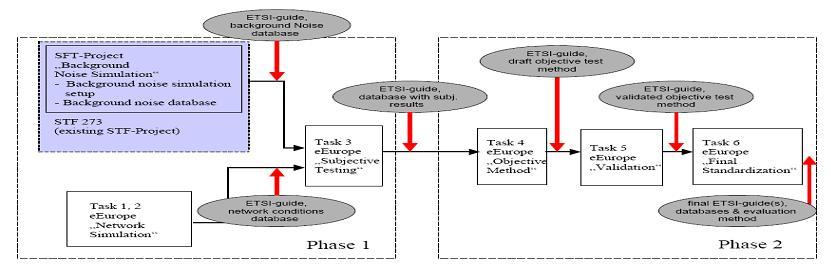
Tasks of Phase 1
Task 1:
Transmission network simulation
-
Evaluation of simulation methodologies
and tools
- Choice of the best simulation
methodologies and tools
- Setup of simulation environment in the
laboratories of the STF experts
- Validation of the simulation
environment
Task 2: Database for transmission networks
and conditions evaluation/simulation
-
Definition of the different network
scenarios and conditions to be recorded
- Preparation of the simulation
recordings
- Editing and preparing the data base
- Description of the data base
(Milestone A)
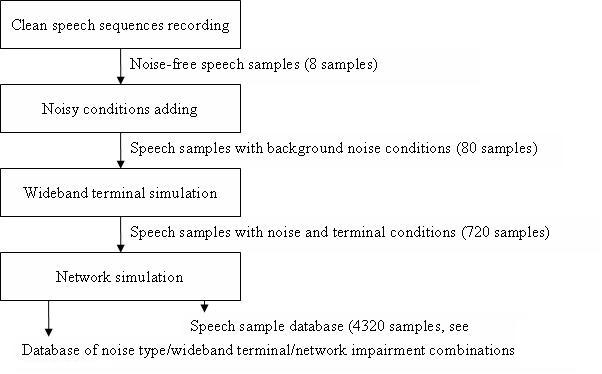
Figure: Workflow of Task 2, Phase 1
Task 3: Subjective tests
-
Preparation of the test material
- Conducting experts tests
- Evaluation of the experts test results
- Preparing test material for naïve
listeners tests
- Conducting naïve listeners tests (2
languages : French and Czech)
- Evaluation of the results
- Statistical analysis
- Description of the test results
(Milestone B1)
Phase 1 – Links
to detailed presentations
Tasks of Phase
2:
-
Task 2: Development of new objective model for estimation of N-MOS, S-MOS and
G-MOS, further analyses
-The N-MOS and S-MOS calculations of the present objective model are based
on the Relative Approach. Due to the time variant characteristic of speech
and most of the background noise signals, the 3D Relative Approach
spectrograph always shows a deviation between the expected and the current
signal which is indicated by patterns in the time-variant signal.
-The G-MOS is then calculated by applying a linear, quadratic regression
algorithm to N-MOS and S-MOS.
-
Task 3: Result Validation
-The new objective model is in principle applicable
for both databases
-Different regression coefficient sets are needed in order to reproduce the
different level strategies used in the two datasets and listening tests
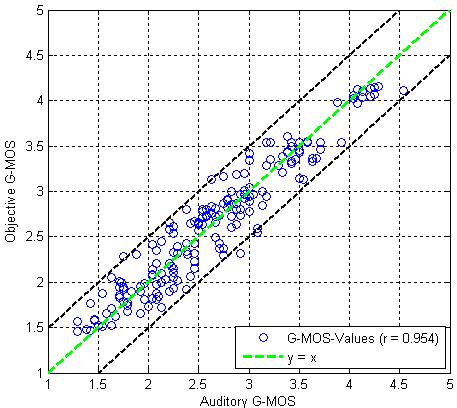
-As an example, objective vs. auditory G-MOS for French samples is depicted
in the following figure:
Time plan for the work:
Part 1 has been published in
December 2005.
Part 2 has been published in September 2006.
Part 3 is expected to be published in September 2007.
How to contact us:
If you would like more information, please contact the STF
Leader:
Phase 1: vincent.barriac@rd.francetelecom.com
Phase 2: h.w.gierlich@head-acoustics.de
Note: this information is based upon STF working assumptions.
The views expressed do not necessarily represent the position of ETSI in this
context.