Specialist Task Force 324:
Extending e-Inclusion for Public
Internet Access Points (PIAPs)
Who we are:
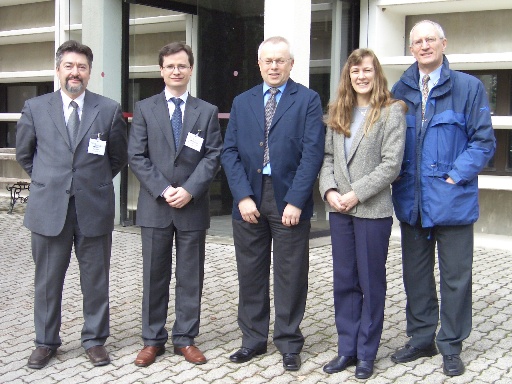
Team Leader: Mike Pluke
Françoise Petersen
Team Members: Valentin Alonso Alvarez
Mikael Goldstein
ETSI Human
Factors:
Technical Officer: Ted Laverack
What we do :
This EC/EFTA funded STF will produce the following ETSI Technical
Specification:
Your input to and comments on our draft are welcome!
The ETSI Technical Specification will establish and set out guidance for
providers and operators of Public Internet Access Points (PIAPs). A "Design for
All" approach will be followed to ensure that PIAPs will be more readily
accessible to all people, including elderly or disabled users and users from a
wide range of cultural backgrounds.
Our project will identify approaches to enhance eInclusion in the provision
and use of PIAPs. The Technical Specification will:
- address issues that have arisen from previous studies and
reports on the use of PIAPs;
- identify existing standards, recommendations and guidelines
(especially from ETSI, the ITU-T and CEN) that provide useful guidance to reduce
barriers to the use of PIAPs;
- propose new normative requirements, guidelines as well as
updates to existing standards, recommendations and guidelines to support
eInclusion for PIAPs;
- identify the need for and content of new standards,
specifications and guidelines that need to be developed.
Consultation will take place with relevant stakeholders such as groups
representing elderly and disabled users of PIAPs, organisations deploying PIAPs
(especially public authorities) and PIAP manufacturers.
Read our
Terms
of Reference
Why we do it:
This project supports the eEurope 2005 objective "to give
everyone the opportunity to participate in the global information society"
(COM(2002) 263 "eEurope 2005: An information society for all") which includes
easy access to Public Internet Access Points (PIAPs), preferably with broadband
connections, in their communes/municipalities.
For economic, availability and cultural reasons, many
people do not have access to their own facilities for accessing eGovernment,
eLearning, eHealth and eBusiness services. For these people, and for any person
currently remote from their own means of access, PIAPs will be one of the few
ways for people to make use of such services.
The ability of all users to make effective use of PIAPs
will be one of the most important factors that determines how successful PIAPs
will be in extending eInclusion to ensure that the highest number of users make
use of eGovernment, eLearning, eHealth and eBusiness services. Whilst there is
already widespread provision of PIAPs throughout Europe, most do not offer ease
of access to disabled and elderly users. The wide provision of PIAPs cannot be
properly effective unless they are readily accessible to elderly and disabled
people.
The provision of PIAPs in accordance with the guidelines
developed by this project will support eGovernment and the provision of online
health care and also give all citizens, irrespective of age, disability or
cultural background easy access to PIAPs. Buyers of PIAPs, most notably public
authorities, will be able to use the guidelines as a basis for requirements
written into public procurement agreements for the purchase of PIAPs.
How to contact us:
You are welcome to contact us at:
PublicInternetAccess@etsi.org
If you want to discuss with a wider group, use our mail list:
PublicInternetAccess@list.etsi.org
To subscribe, go to:
http://list.etsi.org/PublicInternetAccess.html
Events
Events in 2007
- CEN/ISSS CDFG in Helsinki 7-9 October
- Milestone C approved at ETSI HF#44 in Sophia
Antipolis 24-28 September
- Meeting with Junta de Castilla-La Mancha and
Telefónica Public Telecommunications Toledo 11 July
- Milestone B approved at ETSI HF#43 in Sophia
Antipolis 11-15 June
- Interview with LDICN Leicester 30 April
- CEN/ISSS CDFG in Stockholm 15-17 March
- Milestone A approved at ETSI HF#42 in Sophia
Antipolis 19-23 February
In addition, the STF has visited a great number of
PIAPs.
Planned events
- ETSI HF#44 at ETSI in Sophia-Antipolis Feb
2008
- HFT in Kuala Lumpur, Malaysia 18-21 March 2008
- CEN/ISSS CDFG in Estonia March 2008
- ETSI HF#45 at ETSI in Sophia-Antipolis June
2008
Time plan for the work:
| Milestones |
Work development |
| February 2007 |
Start of work |
| 18 May 2007 |
Table of Contents and Scope |
| 9 September 2007 |
Initial draft |
| 31 December 2007 |
Stable draft |
| 23 May 2008 |
Final draft |
| 31 July 2008 |
Publication of technical specification |
| 19 December 2008 |
Final report to European Commission |
Note: this information is based upon STF working assumptions.
The views expressed do not necessarily represent the position of ETSI in this context.