Access networks for residential customers
The following text is reproduced from ETSI Guide 202 306 (EG 202 306 V1.2.1 (1998-05): "Transmission and Multiplexing (TM); Access networks for residential customers") to provide an overview of existing standards and ongoing work on standards and publicly available specifications in the area of access networks for residential customers.
Contents
1 Scope
4 Overview of existing standards and ongoing activities
4.1 Access Network (AN) architecture and evolution
4.3 Access network external interfaces
4.3.1.1 Analogue telephony for POTS
4.3.2.1 High bit rate Digital Subscriber Line (HDSL)
4.3.2.4 Analogue cable TV distribution
4.3.2.5 Digital cable TV distribution
4.3.3 Existing and potential wireless UNIs
4.4 Access network internal interfaces
4.4.1 Wired AN internal interfaces
4.4.1.6 Cable TV network interfaces
4.4.1.7 Use of interfaces in parallel through Inverse multiplexing
4.4.2 Wireless AN internal interfaces
4.5 Customer premises network and "S" type interfaces
4.5.1 Wired customer premises network interfaces
4.5.2 Wireless customer premises network interfaces
4.6 Access system specifications
4.6.1 Conventional copper access
4.6.3 Fibre In The Loop (FITL)
4.6.4 Fibre To The Curb (FTTC)
4.6.5 Fibre To The Home (FTTH)
4.6.8 P-MP wireless access systems
4.7 Functional requirements for access networks
4.7.2 Access network management
4.7.3 Access network performance
4.8 Cabling standards that are relevant for the connection to access networks
5 Analysis and recommendations
5.1 The proliferation of access standards
5.3 Broadband User Network Interface (UNI) specifications
5.4 An in-house analogue subscriber UNI specification
5.5 The use of a technology independent reference point
5.6 Access to IP based networks
5.7 Analysis of the different solutions for the AN architecture and the AN/SN interface
5.9 Transport of timing information through access networks
5.10 Power requirements of access networks
Intellectual Property Rights
IPRs essential or potentially essential to the present document may have been declared to ETSI. The information pertaining to these essential IPRs, if any, is publicly available for ETSI members and non-members, and can be found in ETR 314: "Intellectual Property Rights (IPRs); Essential, or potentially Essential, IPRs notified to ETSI in respect of ETSI standards", which is available free of charge from the ETSI Secretariat. Latest updates are available on the ETSI Web server (http://webapp.etsi.org/ipr).
Pursuant to the ETSI Interim IPR Policy, no investigation, including IPR searches, has been carried out by ETSI. No guarantee can be given as to the existence of other IPRs not referenced in ETR 314 (or the updates on http://www.etsi.org/legal/home.htm) which are, or may be, or may become, essential to the present document.
Foreword
This ETSI Guide (EG) has been produced by ETSI Technical Committee Transmission and Multiplexing (TM).
The present document is an update of ETR 306 (November 1996) which is herewith outdated. It provides an overview of existing standards and ongoing work on standards and publicly available specifications in the area of access networks for residential customers.
It covers:
- for wired as well as wireless technologies;
- supporting narrowband and broadband services;
- in residential environments;
- standardization activities in the following areas:
- transport architecture for access networks;
- access network interfaces, in particular the physical layer and medium access control layer at the boundary between the network operator domain and the end user domain;
- operations and maintenance of access networks;
- cabling standards for connection to access networks.
On the basis of the information contained in the overview a number of co-ordination activities are recommended within the overall context of efficient standardization support for the access to the Global Information Infrastructure (GII).
1 Scope
The purpose of the present document is to provide an overview of existing standards and PASs (Publicly Available Specifications) and ongoing standardization work in the field of access networks for residential customers. This overview is intended to show the relationship between the multitude of standardization and specification activities related to access networks. Where it is felt that important aspects are not covered by current work these are pointed out and candidate organizations for the work are identified. This overview of standards and PASs that are relevant for the specification of European residential access networks will be used for tracking and co-ordination of the ongoing standardization work by the Information and Communication Technology Standards Board (ICTSB).
The present document considers all access technologies that can provide a bearer capacity of 64 kbit/s or more in support of narrowband and broadband services. Wired as well as wireless access technologies are covered, including terrestrial broadcasting. Not included in this overview are standards for direct satellite broadcasting or standards related to Low Earth Orbit Satellite and Medium Earth Orbit Satellite systems, because no input on these subjects was provided.
The scope of the present document is limited to the transport aspects of access networks for narrowband and broadband services in residential environments and therefore the present document focuses on layer 1 and medium access control, and the maintenance aspects of these access network layers. The control aspects of access networks, e.g. V5 interfaces, are included. Signaling and higher layer protocols which are passed transparently through access networks are outside of the scope of the present document.
2 References
References may be made to:
a) specific versions of publications (identified by date of publication, edition number, version number, etc.), in which case, subsequent revisions to the referenced document do not apply; or
b) all versions up to and including the identified version (identified by "up to and including" before the version identity); or
c) all versions subsequent to and including the identified version (identified by "onwards" following the version identity); or
d) publications without mention of a specific version, in which case the latest version applies.
NOTE 1: As described in the Scope above, the purpose of the present document is to give "an overview of existing standards and PASs and ongoing standardization work". Therefore, for completeness, the references below include documents which are not currently publicly available (e.g. for reference [24] we find "DTS/TM-03024" which is an ETSI work program reference number for a document which is intended to be published as an ETSI Technical Specification). Documents that are referred to in the text for explanatory purposes but that do not contain access network specific elements are not included in this list to limit its length.
NOTE 2: For those not familiar with the large variety of ETSI deliverables, the following abbreviations apply:
New regime: EN European Standard
ES ETSI Standard
EG ETSI Guide
TS Technical Specification
TR Technical Report
Old regime: TBR Technical Basis for Regulation
(I)-ETS (Interim) - European Telecommunication Standard
ETR ETSI Technical Report
A TBR is generated by ETSI at the request of the Commission of the European
Community (CEC) for a harmonized standard for type approval purposes, and
provides essential requirements, usually from existing ETSI deliverables.
A CTR is the technical reference published by the CEC to implement the mutual
recognition of conformity assessment within the European Union and refers to a
harmonized standard, such as a TBR.
[1] ATM Forum BTD-RBB-001.04: "Baseline text for the Residential Broadband Working Group".
[2] ATM Forum LTD-RBB-001.04: "RBB Living List".
[3] ATM Forum AF-PHY-0086.00: "Inverse Multiplexing for ATM (IMA) Specification", Version 1.0, July 1997.
[4] CEPT Recommendation T/R 13-01 (1993): "Preferred channel arrangements for fixed services in the range 1-3 GHz".
[5] CEPT Recommendation T/R 22-06 (1994): "Harmonized radio frequency bands for High Performance Radio Local Area Networks (HIPERLANs) in the 5 GHz and 17 GHz frequency range".
[6] CEPT Recommendation T/R 52-01: "Designation of a harmonized frequency band for multipoint video distribution systems in Europe".
[7] DAVIC part 04: "Delivery System Architecture and Interfaces".
[8] DAVIC part 08: "Lower layer protocols and physical interfaces".
[9] DAVIC : "MMDS specification and LMDS specification".
[10] DTR/BRAN-10-08: "BRAN; High Performance Radio Local Area Networks (HIPERLAN); Multimedia over wireless ATM".
[11] DTR/BRAN-010001: "BRAN; Requirements and architectures for broadband fixed radio access networks".
[12] DTR/BRAN-030001: "BRAN; Inventory of broadband radio technologies and techniques".
[13] DEN/EE-02007: "Equipment Engineering (EE); Powering of equipment in access networks".
[14] DTR/SMG-022101: "UMTS; Requirements for the UMTS Terrestrial Radio Access System (UTRA) (UMTS 21.01)".
[15] DTS/SMG-032301: "UMTS Network Aspects; General UMTS architecture; part 1: functional model and network architecture".
[16] DTS/SMG-032310: "UMTS Network Aspects; Services provided by the UMTS Radio Access Network (URAN) (UMTS 23.10)".
[17] DTR/SMG-103320: "UMTS; Security principles for the UMTS (UMTS 33.20)".
[18] DEN/SPS-03047-1: "V interfaces at the digital Service Node (SN); Interfaces at VB5.2 reference point for the support of broadband or combined narrowband and broadband Access Networks; part 1: Interface specification".
[19] DEN/SPS-03047-2: "V interfaces at the digital Service Node (SN); Interfaces at VB5.2 reference point for the support of broadband or combined narrowband and broadband Access Networks; part 2: Protocol Implementation Conformance Statement".
[20] DEN/SPS-03054-1: "V interfaces at the digital Service node; PSTN and ISDN delivery over an ISDN-BA transmission system; part 1: Interface specification".
[21] DEN/SPS-03054-2: "V interfaces at the digital Service node; PSTN and ISDN delivery over an ISDN-BA transmission system; part 2: Protocol Implementation Conformance Statement (PICS) proforma specification".
[22] DEN/SPS-03059-1: "CTM services in the Access Network to be supported by the V5 interface; part 1: CTM service interface specification".
[23] DEN/SPS-03062-1: "Internet Access; V5.2 controlled Internet Access in the AN, phase 1; part 1: Interface Specification".
[24] DTS/TM-03024: "Transmission and Multiplexing (TM); Generic functional architecture for access networks".
[25] DEN/TM-04026-2: "Transmission and Multiplexing (TM); Conformance testing for radio relay systems; part 2: Additional parameters for P-MP equipment".
[26] DTR/TM—04032-2: "Transmission and Multiplexing (TM); Digital Radio Relay Systems (DRRS); CDMA point-to-multipoint digital systems in the band 1 to 3 GHz".
[27] DTR/TM-04038: "Transmission and Multiplexing (TM); Point-to-multipoint radio relay systems (1-3 GHz) in the access network".
[28] DEN/TM-04042: "Transmission and Multiplexing (TM); DS-CDMA point-to-multipoint digital systems in the band 3 to 11 GHz".
[29] DEN/TM-04045: "Transmission and Multiplexing (TM); Frequency Division Multiple Access (FDMA) point to multipoint Digital Radio Relay Systems (DRRS) in the band 1 to 3 GHz".
[30] DEN/TM-04046: "Transmission and Multiplexing (TM); Frequency Division Multiple Access (FDMA) point to multipoint Digital Radio Relay Systems (DRRS) in the band 3 to 11 GHz".
[31] DEN/TM-04049: "Transmission and Multiplexing (TM); Antennas for use in P-MP radio systems in the 3-11 GHz band".
[32] DEN/TM-04050-1: "Transmission and Multiplexing (TM); P-MP DRRSs in the bands 24,25 to 29,5 GHz using different access methods; part 1: Basic parameters".
[33] DEN/TM-04050-2: "Transmission and Multiplexing (TM); P-MP DRRSs in the bands 24,25 to 29,5 GHz using different access methods; part 2: FDMA methods".
[34] DEN/TM-04050-3: "Transmission and Multiplexing (TM); P-MP DRRSs in the bands 24,25 to 29,5 GHz using different access methods; part 3: TDMA methods".
[35] DEN/TM-04050-4: "Transmission and Multiplexing (TM); MP DRRSs in the bands 24,25 to 29,5 GHz using different access methods; part 4: CDMA methods".
[36] DEN/TM-04055: "Transmission and Multiplexing (TM); Point to multipoint digital radio systems below 1 GHz".
[37] DEN/TM-04057: "Transmission and Multiplexing (TM); Antennas for use in P-MP radio systems in the 11-60 GHz band".
[38] DEN/TM-04058: "Transmission and Multiplexing (TM); FH-CDMA point to multipoint digital systems in the band 1-3 GHz".
[39] DEN/TM-04059: "Transmission and Multiplexing (TM); FH-CDMA point to multipoint digital systems in the band 3-11 GHz".
[40] DEN/TM-04060: "Transmission and Multiplexing (TM); Antennas for point to multipoint radio links in the bands 1-3 GHz".
[41] DTS/TM-06003-1: "Transmission and Multiplexing (TM); Very High Speed Subscriber Lines (VDSL); part 1-functional requirements".
[42] DEN/TMN-00003: "V interfaces at the digital Service Node (SN); Management interfaces associated with the VB5.2 reference point; part 1: Interface specification".
[43] D EN/TMN-00004: "V interfaces at the digital Service Node (SN); Management interfaces associated with the VB5.1 reference point; part 1: Interface specification".
[44] DEN/TMN-00012: "Transmission and Multiplexing (TM); Management of generalized Access Networks (ANs)".
[45] DTR/TMN-00015: "Transmission and Multiplexing (TM); Operation And Maintenance (OAM) of Optical Access Networks (OANs); Test and performance fragment".
[46] DTR/TMN-00020: "Transmission and Multiplexing (TM); Operation And Maintenance (OAM) of Optical Access Networks (OANs); Transmission fragment (element view)".
[47] DTR/TMN-00021: "Operations and Maintenance (O&M) of Optical Access Networks (OANs); Ensembles applicable to OANs".
[48] DTR/TMN-00023: "Management of the Access Network (AN)".
[49] DES/TMN-00025: "Transmission and Multiplexing (TM); Service provisioning ensemble of access networks".
[50] ETR 056: "Radio Equipment and Systems (RES); Digital Enhanced Cordless Telecommunications (DECT) System description document".
[51] ETR 080: "Transmission and Multiplexing (TM); Integrated Services Digital Network (ISDN) basic rate access; Digital transmission system on metallic local lines".
[52] ETR 119: "Network Aspects (NA); Open Network Provision (ONP) study on possible new interfaces at the network side of the NT1".
[53] ETR 133: "Radio Equipment and Systems (RES); High PErformance Radio Local Area Networks (HIPERLAN); System definition".
[54] ETR 139: "Radio Equipment and Systems (RES); Radio in the Local Loop (RLL)".
[55] TS 101 135 V1.4.1: "Transmission and Multiplexing (TM); High bitrate Digital Subscriber Line (HDSL) transmission system on metallic local lines; HDSL core specification and applications for 2 048 kbit/s based access digital sections".
[56] ETR 154: "Digital Video Broadcasting (DVB); (DVB) Implementation guidelines for the use of MPEG 2 systems; Video and Audio in satellite and cable broadcasting applications".
[57] ETR 162: "Digital Video Broadcasting (DVB); Allocation of Service Information (SI) codes for DVB systems".
[58] ETR 178: "Digital Enhanced Cordless Telecommunications (DECT); A high level guide to DECT standardization".
[59] ETR 185: "Digital Enhanced Cordless Telecommunications (DECT); Data Services Profile (DSP); Profile overview".
[60] ETR 211: "Digital Video Broadcasting (DVB); DVB guidelines on implementation and usage of Service Information (SI)".
[61] ETR 240: "Transmission and Multiplexing (TM); Optical Access Networks (OANs); Operations and Maintenance (OAM) of Optical Access Networks (OANs)".
[62] ETR 242: "Signalling Protocols and Switching (SPS); Open Network Provision (ONP) standardization for access to the local loop".
[63] ETR 248: "Transmission and Multiplexing (TM); Use of single-mode fibre in the access network".
[64] ETR 257: "Signalling Protocols and Switching (SPS); V interfaces at the digital Service Node (SN); Identification of the applicability of existing protocol specifications for a VB5 reference point in an access arrangement with Access Networks (ANs)".
[65] ETR 308: "Radio Equipment and Systems (RES); Digital Enhanced Cordless Telecommunications (DECT); Services, facilities and configurations for the DECT Radio local loop".
[66] ETR 310: "Radio Equipment and Systems (RES); Digital Enhanced Cordless Telecommunications (DECT); Traffic capacity and spectrum requirements for multi-system and multi-service DECT applications co-existing in a common frequency band".
[67] ETR 312: "Special Mobile Group (SMG); Scenarios and considerations for the introduction of the Universal Mobile Telecommunications System (UMTS)".
[68] ETR 326, edition 1: "Transmission and Multiplexing (TM); B-ISDN access".
[69] ETR 326, edition 2: "Transmission and Multiplexing (TM); Broadband access". (DTR/TM-03075)
[70] ETR 328: "Transmission and Multiplexing (TM); Asymmetric Digital Subscriber Line (ADSL); Requirements and performance".
[71] EN 50083-1: "Cabled distribution systems for television and sound signals; part 1: Safety requirements".
[72] EN 50083-2: "Cabled distribution systems for television and sound signals; part 2: Electromagnetic compatibility for equipment".
[73] EN 50083-3: "Cabled distribution systems for television and sound signals; part 3: Active coaxial wideband distribution equipment".
[74] EN 50083-4: "Cabled distribution systems for television and sound signals; part 4: Passive coaxial wideband distribution equipment".
[75] EN 50083-5: "Cabled distribution systems for television and sound signals; part 5: Headend equipment".
[76] EN 50083-6: "Cabled distribution systems for television and sound signals; part 6: Optical equipment".
[77] EN 50083-7: "Cabled distribution systems for television and sound signals; part 7: System performance".
[78] EN 50083-8: "Cabled distribution systems for television and sound signals; part 8: Electromagnetic compatibility for equipment".
[79] EN 50083-9: "Cabled distribution systems for television and sound signals; part 9: Interfaces for CATV/SMATV head-end and similar professional equipment".
[80] EN 50083-10: "Cabled distribution systems for television and sound signals; part 10: System performance and associated methods of measurement for return channel transmission in multimedia applications".
[81] EN 50083-11: "Cabled distribution systems for television and sound signals; part 11: DVB interaction channel (DVB-RC-126)".
[82] EN 50098-1: "Customer premises cabling for Information Technology; part 1: ISDN basic access".
[83] EN 50098-2: "Customer premises cabling for Information Technology; part 2: 2 048 kbit/s ISDN primary access and leased line network interface".
[84] EN 50173: "Information Technology - Generic cabling systems".
[85] EN 50174-1/2/3: "Information Technology -cabling systems installation".
[86] EN 50201: "Interfaces for digital video broadcast integrated receiver decoder (DVB-IRD)".
[87] EN 50221: "Common interface specification for conditional access and other digital video broadcasting decoder applications".
[88] EN 50256: "Characteristics of DVB receivers".
[89] prEN 50288: "Generic data cable specification; part 1-6"
[90] EN 301 005-1: "V interfaces at the digital Service Node (SN); Interfaces at the VB5.1 reference point for the support of broadband or combined narrowband and broadband Access Networks (ANs), part 1: Interface specification".
[91] EN 301 005-2 : "V interfaces at the digital Service Node (SN); Interfaces at the VB5.1 reference point for the support of broadband or combined narrowband and broadband Access Networks (ANs), part 2: Protocol Implementation Conformance Statement (PICS) proforma specification".
[92] EN 301 021: "Transmission and Multiplexing (TM); Digital Radio Relay Systems (DRRS); Time Division Multiple Access (TDMA) point-to-multipoint DRRS in frequency bands in the range 3 GHz to 11 GHz".
[93] EN 301 055: "Transmission and Multiplexing (TM); Digital Radio Relay Systems (DRRS); Direct Sequence Code Division Multiple Access (DS-CDMA) point-to-multipoint DRRS in frequency bands in the range 1 GHz to 3 GHz".
[94] EN 301 192: "Digital Video Broadcasting (DVB); DVB specification for data broadcasting".
[95] ETS 300 001: "Attachments to the Public Switched Telephone Network (PSTN); General technical requirements for equipment connected to an analogue subscriber interface in the PSTN".
[96] ETS 300 011-1: "Integrated Services Digital Network (ISDN); Primary rate User Network Interface (UNI); part 1: Layer 1 specification".
[97] ETS 300 011-2: "Integrated Services Digital Network (ISDN); Primary rate User Network Interface (UNI); part 2: Conformance test specification for interface IA and IB
[98] ETS 300 011-3: "Integrated Services Digital Network (ISDN); Primary rate User Network Interface (UNI); part 3: Implementation Conformance Statement (ICS) and Implementation eXtra Information for Testing (IXIT) proforma specification for interface IA and IB".
[99] ETS 300 233: "Integrated Services Digital Network (ISDN); Access digital section for ISDN primary rate".
[100] ETS 300 012-1: "Integrated Services Digital Network (ISDN); Basic User Network Interface (UNI); part 1: Layer 1 specification".
[101] ETS 300 012-2: "Integrated Services Digital Network (ISDN); Basic User Network Interface (UNI); part 2: Implementation Conformance Statement (ICS) and Implementation eXtra Information for Testing (IXIT) for interface IA".
[102] ETS 300 012-3: "Integrated Services Digital Network (ISDN); Basic User Network Interface (UNI); part 3: Implementation Conformance Statement (ICS) and Implementation eXtra Information for Testing (IXIT) for interface IB".
[103] ETS 300 012-4: "Integrated Services Digital Network (ISDN); Basic User Network Interface (UNI);
[104] ETS 300 012-5: "Integrated Services Digital Network (ISDN); basic rate user-network interface; part 5: Conformance test specification for interface IB".
[105] ETS 300 012-6: "Integrated Services Digital Network (ISDN); Basic User Network Interface (UNI); part 6: Abstract Test Suite (ATS) specification for interface IA".
[106] ETS 300 012-7: "Integrated Services Digital Network (ISDN); Basic User Network Interface (UNI); part 7: Abstract Test Suite (ATS) specification for interface IB".
[107] ETS 300 175-1: "Radio Equipment and Systems (RES); Digital Enhanced Cordless Telecommunications (DECT) Common Interface (CI), part 1: Overview".
[108] ETS 300 175-2: "Radio Equipment and Systems (RES); Digital Enhanced Cordless Telecommunications (DECT) Common Interface (CI); part 2: Physical layer (PHL)".
[109] ETS 300 175-3: "Radio Equipment and Systems (RES); Digital Enhanced Cordless Telecommunications (DECT) Common Interface (CI); part 3: Medium Access Control (MAC) layer".
[110] ETS 300 175-7: "Radio Equipment and Systems (RES); Digital Enhanced Cordless Telecommunications (DECT) Common Interface (CI); part 7: Security features".
[111] ETS 300 288: "Business TeleCommunications (BTC); 64 kbit/s digital unrestricted leased line with octet integrity (D64U); Network interface presentation".
[112] I-ETS 300 291: "Network Aspects (NA); Functional specification of Customer Administration (CA) on the Operations System/Network Element (OS/NE) interface".
[113] ETS 300 299: "Broadband Integrated Services Digital Network (B-ISDN); Cell based user network access; Physical layer interfaces for B-ISDN applications".
[114] ETS 300 300 (V1.1): "Broadband Integrated Services Digital Network (B-ISDN); Synchronous Digital Hierarchy (SDH) based user network access; Physical layer interfaces for B-ISDN applications".
[115] ETS 300 324-1: "Signalling Protocols and Switching (SPS); V interfaces at the digital Local Exchange (LE); V5.1 interface for the support of Access Network (AN); part 1: V5.1 interface specification".
[116] ETS 300 328: "Radio Equipment and Systems (RES); Wideband transmission systems; Technical characteristics and test conditions for data transmission equipment operating in the 2.4 GHz ISM band and using spread spectrum modulation techniques".
[117] ETS 300 347-1: "Signalling Protocols and Switching (SPS); V interfaces at the digital Local Exchange (LE); V5.2 interface for the support of Access Network (AN); part 1: V5.2 interface specification".
[118] ETS 300 370: "Radio Equipment and Systems (RES); Digital Enhanced Cordless Telecommunications (DECT); Global System for Mobile communications (GSM); DECT/GSM Interworking Profile (IWP); Access and mapping (protocol/procedure description for 3,1 kHz speech service)".
[119] ETS 300 376-1: "Signalling Protocols and Switching (SPS); Q3 interface at the Access Network (AN) for configuration management of V5 interfaces and associated user ports; part 1: Q3 interface specification".
[120] ETS 300 377-1: "Signalling Protocols and Switching (SPS); Q3 interface at the Local Exchange (LE) for configuration management of V5 interfaces and associated customer profiles; part 1: Q3 interface specification".
[121] ETS 300 377-2: "Signalling Protocols and Switching (SPS); Q3 interface at the Local Exchange (LE) for configuration management of V5 interfaces and associated customer profiles; part 2: Managed Objects Conformance Statement (MOCS) proforma specification".
[122] ETS 300 378-1: "Signalling Protocols and Switching (SPS); Q3 interface at the Access Network (AN) for fault and performance management of V5 interfaces and associated user ports; part 1: Q3 interface specification".
[123] ETS 300 378-2: "Signalling Protocols and Switching (SPS); Q3 interface at the Access Network (AN) for fault and performance management of V5 interfaces and associated user ports; part 2: Managed Objects Conformance Statement (MOCS) proforma specification".
[124] ETS 300 379-1: "Signalling Protocols and Switching (SPS); Q3 interface at the Local Exchange (LE) for fault and performance management of V5 interfaces and associated customer profiles; part 1: Q3 interface specification".
[125] ETS 300 401: "Digital Audio Broadcasting (DAB); DAB to mobile, portable and fixed receivers".
[126] ETS 300 418: "Business TeleCommunications (BTC); 2 048 kbit/s digital unstructured and structured leased lines (D2048U and D2048S); Network interface presentation".
[127] ETS 300 421: "Digital Video Broadcasting (DVB); Framing structure, channel coding and modulation for 11/12 GHz satellite services".
[128] ETS 300 429: "Digital Video Broadcasting (DVB); Framing structure, channel coding and modulation for cable systems".
[129] ETS 300 434: "Radio Equipment and Systems (RES); Digital Enhanced Cordless Telecommunications (DECT); Integrated Services Digital Network (ISDN); DECT/ISDN interworking for end system configuration; part 1: Interworking specification".
[130] ETS 300 444: "Radio Equipment and Systems (RES); Digital Enhanced Cordless Telecommunications (DECT); Generic Access Profile (GAP)".
[131] ETS 300 448: "Business teleCommunications (BTC); Ordinary quality voice bandwidth 2-wire analogue leased line (A2O); Connection characteristics and network interface presentation".
[132] ETS 300 449: "Business teleCommunications (BTC); Special quality voice bandwidth 2-wire analogue leased line (A2S); Connection characteristics and network interface presentation".
[133] ETS 300 451: "Business teleCommunications (BTC); Ordinary quality voice bandwidth 4-wire analogue leased line (A4O); Connection characteristics and network interface presentation".
[134] ETS 300 452: "Business teleCommunications (BTC); Special quality voice bandwidth 4-wire analogue leased line (A4S); Connection characteristics and network interface presentation".
[135] ETS 300 463: "Transmission and Multiplexing (TM); Requirements of passive Optical Access Networks (OANs) to provide services up to 2 Mbit/s bearer capacity.
[136] ETS 300 468: "Digital Video Broadcasting (DVB); Specification for Service Information (SI) in DVB Systems".
[137] ETS 300 472: "Digital Video Broadcasting (DVB); Specification for conveying ITU-R System B Teletext in DVB bitstreams".
[138] ETS 300 473: "Digital Video Broadcasting (DVB); DVB Satellite Master Antenna Television (SMATV) distribution systems".
[139] ETS 300 534 (V4.4.1): "Digital cellular telecommunications system (Phase 2); Security related network functions (GSM 03.20)".
[140] ETS 300 550: "European digital cellular telecommunications system (Phase 2); Mobile Station - Base Station System (MS-BSS) interface General aspects and principles (GSM 04.01)".
[141] ETS 300 573: "Digital cellular telecommunications system (Phase 2); Physical layer on the radio path; General description (GSM 05.01)".
[142] ETS 300 612-1: "Digital cellular telecommunications system (Phase 2); Network Management (NM); part 1: Objectives and structure of Network Management (GSM 12.00)".
[143] ETS 300 636: "Transmission and Multiplexing (TM); Time Division Multiple Access (TDMA) point-to-multipoint digital systems in the band 1 to 3 GHz".
[144] ETS 300 651: "Radio Equipment and Systems (RES); Digital Enhanced Cordless Telecommunications (DECT); Data Services Profile (DSP); Generic data link service; Service Type C, Class 2".
[145] ETS 300 652: "Radio Equipment and Systems (RES); High PErformance Radio Local Area Networks (HIPERLAN) Type 1; Functional specification".
[146] ETS 300 681: "Transmission and Multiplexing (TM); Optical Distribution Network (ODN) for Optical Access Network (OAN)".
[147] ETS 300 701: "Radio Equipment and Systems (RES); Digital Enhanced Cordless Telecommunications (DECT); Data Services Profile (DSP); Generic frame relay service with mobility (service types A and B, class 2)".
[148] CLC/Technical Committee 205(SEC)175A: "HBES report no. 4; Applications and requirements - Class 2 and 3 [CENELEC TC 205]".
[149] ETS 300 742: "Transmission and Multiplexing (TM); Physical layer User Network Interface (UNI) for 2 048 kbit/s Asynchronous Transfer Mode (ATM) signals".
[150] ETS 300 744: "Digital Video Broadcasting (DVB); Framing structure, channel coding and modulation for digital terrestrial television". (Based on DVB Technical Module TM1 354).
[151] ETS 300 748: "Digital Video Broadcasting (DVB); Framing structure, channel coding and modulation for Multipoint Video Distribution Systems (MVDS) at 10 GHz and above".
[152] ETS 300 749: "Digital Video Broadcasting (DVB); Framing structure, channel coding and modulation for Multipoint Multichannel Distribution Systems (MMDS) systems below 10 GHz".
[153] ETS 300 755: "Radio Equipment and Systems (RES); Digital Enhanced Cordless Telecommunications (DECT); Data services profile (DSP); Multimedia Messaging Service (MMS) with specific provision for facsimile services; (Service type F, class 2)".
[154] ETS 300 756: "Radio Equipment and Systems (RES); Digital Enhanced Cordless Telecommunications (DECT); Global System for Mobile communications (GSM); DECT/GSM Interworking Profile (IWP); Implementation of bearer services".
[155] ETS 300 765: "Radio Equipment and Systems (RES); Digital Enhanced Cordless Telecommunications (DECT); Radio in the Local Loop (RLL) Access Profile (RAP); part 1: Basic telephony services".
[156] ETS 300 766: "Business TeleCommunications (BTC); Multiple 64 kbit/s digital unrestricted leased lines with octet integrity presented at a structured 2 048 kbit/s interface at either or both ends (D64M); Connection characteristics and network interface presentation".
[157] ETS 300 792: "Radio Equipment and Systems (RES); Digital Enhanced Cordless Telecommunications (DECT); Global System for Mobile communications (GSM); DECT/GSM interworking profile (IWP); Implementation of facsimile group 3".
[158] ETS 300 795: "Signalling Protocols and Switching (SPS); Access Network (AN) supporting V5; Transmission characteristics and performance design objectives for call handling and bearer channel connection management".
[159] ETS 300 800: "Digital Video Broadcasting (DVB); Interaction channel for Cable TV distribution systems (CATV)".
[160] ETS 300 801: "Digital Video Broadcasting (DVB); Interaction channel through Public Switched Telecommunications Network (PSTN)/ Integrated Services Digital Networks (ISDN)".
[161] I-ETS 300 811: "Transmission and Multiplexing (TM); Broadband Integrated Services Digital Network (B-ISDN); Transmission Convergence (TC) and Physical Media Dependent(PMD) sublayers for the SB reference point at a bit-rate of 25,6 Mbit/s over twisted pair cable".
[162] ETS 300 822: "Radio Equipment and Systems (RES); Digital Enchanced Cordless Telecommunications (DECT); Integrated Services Digital Network (ISDN); DECT/ISDN interworking for intermediate system configuration; Interworking and profile specification".
[163] ETS 300 824: "Radio Equipment and Systems (RES); Digital Enhanced Cordless Telecommunications (DECT); Cordless Terminal Mobility (CTM); CTM Access Profile (CAP)".
[164] IEEE 802:10: "IEEE standards for local and metropolitan area networks: Interoperable LAN/MAN Security (SILS): Secure Data Exchange (SDE) sublayer management and recommended practice for SDE on Ethernet V2.0 in IEEE 802 LANs".
[165] IEEE 802.14-94/002R3: "IEEE P 802.14 Cable-TV functional requirements and evaluation criteria".
[166] IEEE 802.14-Draft 2 Revision 2: "Cable-TV Access Method and Physical Layer Specification".
[167] ISO/IEC 8802-2 (1994) [ANSI/IEEE 802.2, 1994 Edition]: "Information technology-Telecommunications and information exchange between systems - Local and Metropolitan area networks - Specific requirements, part 2: Logical link control".
[168] ISO/IEC 8802-3: "Information technology; Local and metropolitan area networks; part 3: Carrier sense multiple access with collision detection (CSMA/CD) access method and physical layer specifications".
[169] ISO/IEC 11801: "Information Technology; Generic Cabling for Customer Premises".
[170] ITU-T Recommendation G.902: "Framework recommendation on functional access networks".
[171] ITU-T Recommendation G.960: "Digital section for ISDN basic rate access".
[172] ITU-T Recommendation G.962: "Access digital section for ISDN primary rate access at 2 048 kbit/s".
[173] Draft ITU-T Recommendation G.96x: "Access Digital Section for B-ISDN".
[174] ITU-T Recommendation G.964: "V interfaces at the digital local exchange (LE) -V5.1 interface (based on 2 048 kbit/s) for the support of access network (AN)".
[175] ITU-T Recommendation G.965: "V interfaces at the digital local exchange (LE) -V5.2 interface (based on 2 048 kbit/s) for the support of access network (AN)".
[176] ITU-T Recommendation G.982: "Optical access networks to support services up to the ISDN primary rate or equivalent bit rates".
[177] Draft ITU-T Recommendation G.983: "Optical Access Network to support services greater than the ISDN primary rate".
[178] Draft ITU-T Recommendation G.hdsl: "High bit rate Digital Subscriber Line (HDSL) transmission system on metallic local lines; HDSL core specification and applications for 2 048 kbit/s based access digital sections".
[179] Draft ITU-T Recommendation G.967.1: "V interfaces at the digital Service Node (SN); Interfaces at the VB5.1 reference point for the support of broadband or combined narrowband and broadband Access Networks".
[180] Draft ITU-T Recommendation G.VB52: "V interfaces at the digital Service Node (SN); Interfaces at VB5.2 reference point for the support of broadband or combined narrowband and broadband Access Networks".
[181] ITU-T Recommendation I.112: "Vocabulary of terms for ISDNs".
[182] ITU-T Recommendation I.113: "Vocabulary of terms for broadband aspects of ISDN".
[183] Draft ITU-T Recommendation I.375.z: "Network capabilities to support multimedia services - Example of multimedia distribution service class, Switched Digital Broadcasting (SDB)".
[184] ITU-T Recommendation I.411: "ISDN User-Network Interfaces - Reference Configurations".
[185] ITU-T Recommendation I.413: "ISDN User-Network Interfaces - B-ISDN User-Network Interface".
[186] ITU-T Recommendation I.414: "ISDN User-Network Interfaces - Overview of recommendations on layer 1 for ISDN and B-ISDN customer access".
[187] ITU-T Recommendation I.430: "Basic user-network interface - Layer 1 specification".
[188] ITU-T Recommendation I.431: "Primary rate user-network interface - Layer 1 specification".
[189] ITU-T Recommendation I.432.1: "B-ISDN user-network interface physical layer specification - general characteristics".
[190] ITU-T Recommendation I.432.2: "B-ISDN UNI Physical layer specification for 155 520 kbit/s and 622 080 kbit/s".
[191] ITU-T Recommendation I.432.3: "B-ISDN UNI Physical layer specification for 1 544 kbit/s and 2 048 kbit/s".
[192] ITU-T Recommendation I.432.4: "B-ISDN UNI Physical layer specification for 51 840 kbit/s".
[193] ITU-T Recommendation I.432.5: "B-ISDN UNI Physical layer specification for 25 600 kbit/s".
[194] ITU-T Recommendation I.610: "B-ISDN operation and maintenance principles and functions".
[195] ITU-T Recommendation J.1: "Terminology for new services in television and sound programme transmission".
[196] TU-T Recommendation J.82: "Transport of MPEG-2 Constant Bit Rate television signals in B-ISDN".
[197] ITU-T Recommendation J.83: "Digital Multi-programme systems for television, sound and data services for cable distribution".
[198] ITU-T Recommendation J.84: "Distribution of digital multi-programme signals for television, sound and data services through SMATV networks".
[199] Draft ITU-T Recommendation J.150: "Transmission of digital multi-programme signals for television, sound and data services through multichannel, multipoint distribution systems (MMDS)".
[200] ITU-T Recommendation Q.512: "Digital exchange interfaces for subscriber access".
[201] ITU-T Recommendation Q.552: "Transmission characteristics at 2-wire analogue interfaces of digital exchanges".
[202] Draft ITU-T Recommendation Y.120: "GII scenario development methodology".
[203] SP-RFI-I02-971008: "Data over cable interface specifications; Radio frequency interface specification".
[204] SP-CMTS-NSII01-960702: "Data over cable interface specifications; Cable Modem Termination System - Network side interface specification".
[205] T1.413 - issue 2: "Draft Proposed Revision of ANSI T1.413-1995 - Interface Between Networks and Customer Installation - Asymmetric Digital Subscriber Line (ADSL) Metallic Interface".
[206] T1E1/97 - 104R2a: "Draft Proposed American National Standard - Interface Between Networks and Customer Installation - Rate Adaptive Digital Subscriber Line (RADSL) Metallic Interface".
[207] TBR 06 (1993): "Radio Equipment and Systems (RES); Digital European Cordless Telecommunications (DECT) General terminal attachment requirements".
[208] TBR 10 (1993): "Radio Equipment and Systems (RES); Digital European Cordless Telecommunications (DECT) General terminal attachment requirements: telephony applications".
[209] prTBR 21 (1996): "Terminal Equipment (TE); Attachment requirements for pan-European approval for connection to the analogue PSTNs of TE (excluding TE supporting the voice telephony service) in which network addressing, if provided, is by means of DTMF signalling"
[210] TBR 22 (1996): "Radio Equipment and Systems (RES); Attachment requirements for terminal equipment for Digital Enhanced Cordless Telecommunications (DECT) Generic Access Profile (GAP) applications".
[211] TR 101 190: "DVB; Implementation guidelines for DVB terrestrial services; Transmission aspects".
[212] TR 101 200: "DVB; A guideline for the use of DVB specifications and standards".
[213] TR 101 201: "DVB; Interaction channel for SMATV distribution systems; Guidelines for versions based on satellite and coaxial sections".
[214] ITU-T Recommendation G.704 (1995): "Synchronous frame structures used at 1554, 6312, 2048, 8488 and 44 736 kbit/s hierarchical levels".
[215] ITU-T Recommendation G.804 (1993): "ATM cell mapping into plesiochronous digital hierarchy (PDH)".
[216] CEPT/ERC/RECOMMENDATION 25-10: "Frequency ranges for the use of temporary terrestrial ENG/OB video links during events in other CEPT member countries".
[217] EG 201 185: "Terminal Support Interface for Analogue PSTN Terminals".
[218] EG 201 121: "A guide to the application of TBR 21".
[219] ITU-T Recommendation J.112: "Transmission systems for interactive cable television services".
3 Abbreviations
For the purposes of the present document, the following abbreviations apply:
ADSL Asymmetric Digital Subscriber Line AN Access Network ANI Access Network Interface ANSI American National Standards Institute ATM Asynchronous Transfer Mode B-ISDN Broadband -ISDN CAP Carrierless Amplitude Modulation CATV Community Antenna TV CDMA Code Division Multiple Access CEPT Conference of European Posts and Telecommunications Administrations CT2 Cordless Telephone 2nd generation CTM Cordless Terminal Mobility CTR Common Technical Regulation DAVIC Digital Audio-Visual Council DCS 1 800 Digital Cellular System working at 1 800 MHz DECT Digital Enhanced Cordless Telecommunications DTMF Dual Tone Multi Frequency DVB Digital Video Broadcasting EMC ElectroMagnetic Compatibility EMI ElectroMagnetic Interference ENG/OB Electronic News Gathering/Outside Broadcast ERO European Radio Office ESF Extended Superframe EU European Union FDMA Frequency Division Multiple Access FTTC Fibre To The Curb FTTH Fibre To The Home FSAN Full Service Access Network GAP Generic Access Profile GII Global Information Infrastructure GSM Global System for Mobile communications HDSL High bit rate Digital Subscriber Line HFC Hybrid Fibre Coax HIPERLAN High Performance Radio Local Area Network IMT-2000 International Mobile Telecommunications for the year 2000 and beyond IP Internet Protocol IRD Integrated Receiver Decoder ISDN Integrated Services Digital Network ISM Industrial, Scientific and Medical ITU International Telecommunications Union LED Light Emitting Diode LMDS Local Multipoint Distribution System MAC Medium Access Control MMDS Multichannel Multipoint Distribution Systems MOCS Managed Objects Conformance Statement MPEG ISO/IEC Moving Pictures Experts Group MSC Mobile-services Switching Centre MVDS Multipoint Video Distribution System NMT Nordic (Scandinavian) Mobile Telephone system NNI Network Node Interface NT Network Termination OAM Operations, Administration and Management OAN Optical Access Network ONP Open Network Provision PAS Publicly Available Specification PDH Plesiochronous Digital Hierarchy PHY PHYsical layer PICS Protocol Implementation Conformance Statement PIXIT Protocol Implementation eXtra Information for Testing PMD Physical Medium Dependent POF Plastic Optical Fibre PON Passive Optical Network POTS Plain Old Telephony Service PSTN Public Switched Telephone Network QAM Quadrature Amplitude Modulation QPSK Quadrature Phase Shift Keying RBB Residential BroadBand RLL Radio in the Local Loop SDH Synchronous Digital Hierarchy SMATV Satellite Master Antenna TeleVision SNI Service Node Interfaces SS7 Signalling System No. 7 STU Set Top Unit TACS Total Access Communications System TC Transmission Convergence TDMA Time Division Multiple Access TII Technology Independent Interface TMN Telecommunications Management Network UMTS Universal Mobile Telecommunications System UNI User Network Interface VDSL Very high bit rate Digital Subscriber Line VP Virtual Path VSB Vestigial SideBand
4 Overview of existing standards and ongoing activities
This clause gives a brief overview of existing standards and ongoing work. It is not intended to provide a tutorial on Access Networks, because there is already ample tutorial information contained in the documents that are referred to in the following clauses.
The bodies involved in access standards and Publicly Available Specification (PAS) are using different classification schemes for the types of networks they are describing. This overview does not follow any particular existing scheme. The present document emphasizes the interface aspects of ANs and therefore this overview is organized firstly according to the types and capacity of the interfaces that are being specified and secondly according to access system and general functional requirements. This reflects the importance attached by the industry to the definition of standardized interfaces for the interconnection of networks as recently reiterated by the Global Standards Conference (Brussels, 1-3 October 1997). For ANs this implies that priority should be given to external interfaces. It should be recognized however that the choice of external interfaces is as much a commercial and regulatory issue as a technical question. This means that a particular interface may be perceived by one standards group as AN internal, while another group may pursue the same interface as AN external. The undesirable but unavoidable consequence of the classification of interfaces as internal or external is therefore that some interfaces will appear under both. The structure of this overview section is depicted in figure 1.

Figure 1: Structure of the overview section
4.1 Access Network (AN) architecture and evolution
ITU-T Recommendation G.902 [170] is a framework recommendation on the architecture and functions of access networks. It describes access types, management and service node aspects. An AN as defined by ITU-T Recommendation G.902 [170] is bound by User Network Interfaces (UNI) at the customer side and Service Node Interfaces (SNI) at the core network side and does not interpret user-network signalling. ITU-T Recommendation G.902 [170] builds on the concepts that were developed in ETSI in the context of the narrowband SNI (V5) to encompass also broadband access networks (VB5).
ITU-T activities on ANs are studied by various SGs under the lead of SG15. As the Lead Study Group (LSG) for this issue, SG15 has allocated the co-ordination of work on ANs (within ITU SGs as well as co-operation with other fora) to Q.1/15 .
ETR 139 [54] examines the architecture and technologies in use, or under development, in Europe for Radio in the Local Loop (RLL). Cordless technologies: Digital Enhanced Cordless Telecommunications (DECT) and Cordless Telephone 2nd generation (CT2), Cellular technologies: Digital Cellular System working at 1 800 MHz (DCS 1 800), Global System for Mobile communications (GSM), Nordic (Scandinavian) Mobile Telephone system (NMT) and Total Access Communications System (TACS), microwave Point-to-Multipoint (P-MP) systems and spread spectrum Code Division Multiple Access (CDMA) technologies are all being considered.
TR 101 200 [212] provides a guideline to the use of the specifications of the Digital Video Broadcasting (DVB) systems. In its current form this report is an enumeration of the relevant standards document; it does not provide an architectural description.
The Digital Audio Visual Council (DAVIC) Specification part 04 [7] gives an overview of delivery system architecture and interfaces. DAVIC has classified networked delivery systems into cabled, hertzian and hybrid networks. The delivery system is partitioned in a core and AN. A number of wired access network types are distinguished. These are referred to by DAVIC as Asymmetric Digital Subscriber Line (ADSL) AN, Very high bit rate Digital Subscriber Line (VDSL) AN, Fibre To The Curb (FTTC) AN, and Fibre To The Home (FTTH) AN. FTTH ANs are assumed to use "active" Network Terminations (NT). The other types may use "passive" NTs. Terrestrial broadcasting networks have also been addressed by a recent DAVIC call for proposals. The definition of such access networks will be included in future DAVIC Specifications. ETS 300 744 [150] is one of the potential candidates.
ETR 326 [68] describes the architectural principles for Broadband Integrated Services Digital Network (B-ISDN) access. One of the architectures that is covered is that of Asynchronous Transfer Mode Passive Optical Networks (ATM-PON). Work on a revision of this report to cover cascaded transmission systems and non-homogeneous access types has just started under RTR/TM-03075 [69]. ITU-T draft recommendation G.96x [173] on the Broadband Digital Section covers similar issues.
DTS/TM-03024 [24] deals with ongoing work on requirements of Optical Access Networks (OANs) for evolving services. Two ANs types are currently elaborated; so called fibre twisted pair systems and Hybrid Fibre Coax (HFC) passband transmission systems. The latest draft contains a substantive annex with ATM-PON specifications.
Asynchronous Transfer Mode (ATM) Forum BTD-RBB-001.04 [1] documents the progress of the work in the ATM Forum Residential Broadband (RBB) working group. It shows the RBB reference architecture and the interfaces for which the ATM Forum seeks specifications. Ongoing work that is not judged mature enough to enter the baseline text (see [1]) is captured in the RBB living list (see [2]). These include technology specific UNIs, the Access Network Interface (ANI)-called SNI in ITU-T Recommendation G.902 [170]-and the Home UNI.
IEEE 802.14/94-002R3 [165] documents the status of the work of IEEE project 802.14 on Cable TV functional requirements and evaluation criteria for the Medium Access Control (MAC) and physical layer (PHY) standards that are being developed. It includes a logical reference model and a description of the network topologies that should be supported.
Figure 2 shows the reference models that are used in ETSI, the ITU-T, the ATM Forum, DAVIC 1.0 and in DVB. The figure highlights the different terms that are used and their relationship. It should be noted that there is less resemblance between the models than one would think at first sight; this is due to differences in interface and functional definitions.
In ITU-T SG13 work under Q.25/13 on led to Draft Recommendation Y.120 [202] on Global Information Infrastructure (GII) scenario methodology. This methodology describes how a high level reference model may be applied to specific network scenarios. A complementary draft document deals with examples of use of the scenario methodology showing logical and physical representations of a number of access network architectures.

Figure 2: Access network reference models
4.2 Terminology
ITU-T Recommendation I.112 [181] provides terminology for Integrated Services Digital Network (ISDN). ITU-T Recommendation I.113 [182] gives additional vocabulary for the broadband aspects of ISDN. ITU-T Recommendation I.411 [184] describes ISDN UNI reference configurations and explains the concepts of reference points and functional groups. ITU-T Recommendation I.414 [186] provides an overview of recommendations on layer 1 for ISDN and B-ISDN customer access. ITU-T Recommendation J.1 [195] defines terminology for television and sound programme transmission.
There does not seem to be a document that provides a generally accepted set of definitions applicable to access networks; each standard or PAS contains its own set of definitions.
The present document attempts to use the terminology provided by ITU-T Recommendation G.902 [170]. Accordingly, the AN, strictly speaking, does not cease at the entry of the customers premises. The AN is the delivery mechanism from a Network Operators central site up to the Customer Premises Network (CPN) interface with appropriate transmission methods to support the service(s) required. The differentiation in the interface definition for a particular delivery mechanism is that of ownership i.e. public/Network Operator or private/customer. Consequently, that which is termed the Network Terminating Point (NTP) may be a regulatory or contractual break point for one service, e.g. POTS, it is not necessarily the UNI for other services.
The term UNI in the present document is used for the boundary between an end-user domain and a public access network operator domain, not just in case of ISDN but for any type of service. With our definition it depends on the type of AN and market and regulatory considerations whether the UNI is a wired line type interface commonly referred to as a "U" interface, an air-interface or a conventional ISDN "S/T" type interface. With this use of the term UNI the only common technical characteristic of any wired UNI is that it is physically accessible e.g. at a socket or a set of terminals. For a wireless UNI the accessibility requirement translates into the need for a fully specified air-interface.
It should be noted that according to the G.902 definition of an access network, these days an access network operator does not necessarily own the underlying medium. Even for the most basic of services e.g. POTS, it is possible to deliver multiple services over the same loop plant e.g. POTS + ISDN utilizing DSL techniques. If these services are provided by different organizations these are viewed as operating different access networks that happen to share some facilities.
4.3 Access network external interfaces
Ideally standards should define a minimum set of ANIs independent of the access technology being used. The existing interface standards for POTS (Plain Old Telephony Service), narrowband and broadband ISDN could be considered to be such a set. In practice, this approach may however carry a certain cost penalty depending on the access technology of choice. Particularly in the residential environment, which is a very cost sensitive area of the transport infrastructure, the industry is challenged to find a reasonable compromise between initial costs and life cycle costs of the access network: Whereas a low initial cost objective leads to technology specific interfaces, uncontrolled proliferation of different interfaces will tend to increase the life cycle cost of the access infrastructure.
A number of recent initiatives have increased the pace with which new interfaces are being defined. Since many of these are technology specific it is tempting from a tutorial point of view to start with a listing of different access architectures. However it is not the implementation but the interfaces that have been or are being defined that are of prime importance for the GII, because these provide for the connection of end-users to the network (in case of the UNI) and between access and core networks (in the case of the SNI). We will therefore first list existing and new interfaces and background material on underlying system concepts afterwards.
4.3.1 Existing wired UNIs
4.3.1.1 Analogue telephony for POTS
For analogue voice band services ITU-T Recommendation Q.552 [201] specifies the transmission characteristics at 2-wire analogue interfaces of digital exchanges. Strictly speaking it specifies the SNI, but if the AN is a simple twisted pair it can also be considered as a "U" type UNI specification. ETS 300 001 [95] gives general technical requirements for equipment to be connected to an analogue subscriber interface in the PSTN (Public Switched Telephone Network); i.e. it gives requirements that terminal equipment has to satisfy at the UNI. The detailed specification of the POTS UNI varies in Europe per country and can be found in national specifications.
For new access technologies like RLL and Fibre To The Home the analogue subscriber UNI is more like an in-house T-interface. Work has been initiated in ETSI Project ATA in EG 201 185 [217] and in ETSI TM4 under DTR/TM-04070 on the specification of an analogue subscriber interface for short loops.
Data interfaces according to one of the ITU-T V series of Recommendations are in wired residential access networks generally not provided as UNIs, but via a voice band modem or ISDN terminal adaptor connected to a POTS or ISDN UNI. TBR 21 [209] defines the requirements for pan-European approval for connection to the analogue Public Switched Telephone Networks (PSTNs) of Terminal Equipment (TE) (excluding TE supporting the voice telephony service) in which network addressing, if provided, is by means of Dual Tone Multi Frequency (DTMF) signalling. The major national technical differences are described in Advisory Notes which are contained in EG 201 121 [218], produced by EP Analogue Terminals and Access (ATA).
Current wireless access technologies are generally not capable to support the whole range of voice band data services. A 32 kbit/s DECT channel for instance will support voice-band modems up to 4,8 kbit/s (7,2 kbit/s with some degradation) and GSM will only support data services up to 9,6 kbit/s via digital interfaces employing either V.24/V.28 (R interface) or V.110 (S interface). For RLL applications with network operator provided radio terminations at the customer premises these may include data adaptors in which case V-interfaces appear as UNIs.
Broadcasting media are going to be more and more used to convey data uni-or bi-directionally. The protocols defined in ISO/IEC Moving Pictures Experts Group (MPEG) (e.g. DSM/CC) and DAVIC will be important references to define the data interfaces. Special data streams have also been defined for specific applications (e.g. the SI system described in ETS 300 468 [136]).
ETS 300 448 [131] specifies the connection characteristics and network interface presentation for ordinary voice bandwidth 2-wire analogue leased lines; i.e. it specifies the UNI for these leased lines. ETS 300 449 [132] specifies the same for special quality voice bandwidth 2-wire analogue leased lines. It should be noted that the interface presentation is identical. ETS 300 451 [133] and ETS 300 452 [134] are the equivalent standards for ordinary and special quality 4-wire analogue leased lines respectively.
ETS 300 288 [111] specifies the network interface presentation for a 64 kbit/s digital unrestricted leased line with octet integrity. ETS 300 766 [156] concerns the network interface presentation for a nx64 kbit/s leased line. ETS 300 418 [126] specifies the network interface for 2 048 kbit/s digital leased lines with octet integrity.
ITU-T Recommendation I.430 [187] specifies the UNI for basic rate ISDN at the S/T reference point. ETS 300 012-1 [100] identifies which aspects are regarded as normative or informative and gives further requirements or modifications to I.430 [187]. ETS 300 012-2 [101] and ETS 300 012-3 [214] specify the Protocol Implementation Conformance Statement (PICS) and Protocol Implementation eXtra Information for Testing (PIXIT) for the interface IA and IB of the UNI respectively. ETS 300 012-4 [103] and ETS 300 012-5 [104] conformance test specifications for these interfaces and ETS 300 012-6 [105] and ETS 300 012-7 [106] specify the test suites.
ETR 080 [51] describes the characteristics of a digital transmission system which provides a basic rate access digital section. There is ongoing work in ETSI TM6 on a next revision of ETR 080. This basic rate "U" type interface is not provided as an UNI in Europe. A study on technical and economical aspects of a "U" type UNI can be found in ETR 119 [52].
ITU-T Recommendation I.431 [188] specifies the UNI for primary rate ISDN at the S/T reference point. ETS 300 011-1 [96] identifies which aspects are regarded as normative or informative and gives further requirements or modifications to I.431 [188]. ETS 300 011-3 [98] provides implementation conformance statements for interfaces Ia and Ib of the primary rate UNI. ETS 300 011-2 [97] provides the conformance test specs for these interfaces.
ETS 300 233 [99] describes the characteristics of a digital transmission system which provides a primary rate access digital section. This primary rate "U" type interface is not provided as an UNI in Europe.
The Recommendation I.413 [185], B-ISDN User-Network Interface, gives the reference configuration for the B-ISDN user-network interface (UNI) and examples of physical realizations. It describes PHY information flows according to the B-ISDN Protocol reference model and identifies interface functions. It also addresses Operations, Administration and Management (OAM) issues as they relate to the reference configuration at the user access and to the interface specifications.
ITU-T Recommendation I.414 [186] provides an overview of recommendations on layer 1 for ISDN and B-ISDN customer access.
The general characteristics of the B-ISDN UNI are given in ITU-T Recommendation I.432.1 [189].
Draft new ITU-T Recommendation I.432.3 [191] specifies the ATM PHY for a 2 048 kbit/s B-ISDN UNI. ETS 300 742 [149] is concerned with the profiling and test specifications for the ITU-T base standard.
4.3.1.7.2 25 600 kbit/s B-ISDN
Related to medium bit rate UNIs, it is presently under consideration in ETSI TM3 to use the 25.6 Mbit/s B-ISDN interface specified in ETS 300 811 [161] not only at the reference point SB (see subclause 4.5.1.1) but also at TB. I.432.5 [215] is technically identical to the present document. A low cost solution for the necessary OAM functions has been proposed for this case. Further study is required to verify compatibility with the existing solution foreseen at SB. The relation with the OAM functions defined in ITU-T Recommendation I.610 [194] also needs to be considered. An enhancement to the 25,6 Mbit/s interface has also been proposed in the ATM Forum and has been included in the Living List.
Note that the 51 840 kbit/s UNI of ITU-T RecommendationI.432.4 [192] is not listed here because no usage is envisaged in Europe.
4.3.1.7.3 155 520 kbit/s and 622 080 kbit/s B-ISDN
ITU-T Recommendation I.432.2 [190] specifies the ATM PHY for the 155 520 kbit/s and 622 080 kbit/s B-ISDN UNIs. ETS 300 299 [113] is concerned with the profiling and test specifications for the cell based UNIs specified in ITU-T Recommendation I.432.2 [190], while ETS 300 300 [114] covers the Synchronous Digital Hierarchy (SDH) based UNIs in ITU-T Recommendation I.432.2 [190].
It has been proposed to support an SDH based UNI which may only be partly filled with ATM traffic. The remaining capacity could be used for leased lines or left unused. In this scenario an SDH Mux/Cross-connect is foreseen in the access network to groom the traffic. This type of configuration is not addressed by ETS 300 300 [114].
These high bit-rate B-ISDN UNIs are not considered to be of direct interest for residential customer applications.
4.3.2 Potential wired UNIs
4.3.2.1 High bit rate Digital Subscriber Line (HDSL)
Within ETSI, HDSL transmission systems are assumed to be terminated within an AN, similar to the configuration for basic and primary rate access (see subclause 4.4.1.3). DAVIC on the other hand shows access configurations where the HDSL system is terminated internal to a Set Top Unit (STU), implying a "U" type HDSL UNI. For completeness HDSL is therefore listed in this subclause.
Like for HDSL, DAVIC is showing a reference configuration with the ADSL termination integrated into a STU, which is why ADSL is listed as a potential UNI. Activities in ETSI in the field of ADSL which are assuming a network owned ADSL termination at the customer premises are covered under subclause 4.4.1.4.
Proposals in ITU-T SG15 for an ADSL-lite interface specification which lends itself for PCMIA type implementations are also indicative of interest in an ADSL UNI. Work on a new ITU-T Recommendation G.lite has just started.
DAVIC part 08 [8] is providing a complete specification for a point-to-multipoint VDSL system. This specification describes a range of VDSL interfaces with different bit rate combinations as shown in table 1 below:
Table 1: A range of VDSL interfaces
|
Type |
Downstream |
Upstream |
|
A |
51,84 Mbit/s |
19,44 Mbit/s |
|
B |
51,84 Mbit/s |
1,62 Mbit/s |
|
C |
25,92 Mbit/s |
1,62 Mbit/s |
|
D |
12,96 Mbit/s |
1,62 Mbit/s |
The Physical Medium Dependent (PMD) sublayer specification uses Carrierless Amplitude Modulation (CAP) in a 16-CAP constellation in the downstream direction. Upstream, Quadrature Phase Shift Keying (QPSK) modulation is used. The physical medium may be either twisted pair or coax. The Transmission Convergence (TC) PHYsical (PHY) sublayer defines a 810 byte downstream frame and a 71 byte (plus gap) upstream frame both carrying ATM cells. This VDSL interface is defined for the FTTC access architecture. It should be noted that the TC sublayer includes a MAC protocol allowing up to 4 VDSL terminations to be connected to a single UNI. Therefore this interface could be described as a bus "U" type interface. In the DAVIC FTTC architecture the bus is only intended as in-premises distribution wiring; it is not shared with other subscribers.
ETSI TM6 is working on functional requirements for VDSL under work item DTS/TM-06003 [41], (see subclause 4.4.1.5). As yet there are no proposals in ETSI to specify a VDSL based UNI.
4.3.2.4 Analogue cable TV distribution
Detailed specifications for the interface presentation of analogue TV signals at the outlets of cable TV networks in Europe can only be found in national standards. Some common ground can be found in the EN 50 083 [71] series.
4.3.2.5 Digital cable TV distribution
ITU-T Recommendation J.83 [197] deals with the distribution of digital television and sound signals over cable TV networks. This recommendation is derived from ETS 300 429 [128]. It specifies the use of the MPEG2-Transport Stream with a 204 byte framing structure after Reed-Solomon encoding. It specifies Quadrature Amplitude Modulation (QAM) in either a 16-, 32-, or 64-QAM constellation. DAVIC part 08 [8] contains its own version of these specification. It specifies 16-, 64-, or 256-QAM. An example of useful MPEG2-TS bit rates for an 8 MHz channel, without the use of the high reliability marker is given in table 2 below:
Table 2: MPEG2-TS bit rates for an 8 MHz channel
|
Modulation |
MPEG2-TS bit rate |
|
16-QAM |
25,491 Mbit/s |
|
64-QAM |
38,236 Mbit/s |
|
256-QAM |
50,981 Mbit/s |
DAVIC part 08 [8] contains a second interface specification which supports the transport of ATM cells over a cable TV network. The PMD layer is the same as for the MPEG2-TS. This interface packs seven ATM cells plus transport overhead in two 188 byte MPEG2-TS-like packets.
Note that the large capacity of the MPEG-TS may be used for data broadcasting, which is specified as an extension to the DVB MPEG based transmission standards in prEN 301 192 [94]. The present document describes four application areas, namely "data piping", "data streaming", "multiprotocol encapsulation" and "data carousel".
4.3.2.6 Interaction channel for cable TV networks
DAVIC part 08 [8] specifies a bi-directional interaction channel, using QPSK modulation in both directions. The Extended Superframe (ESF) frame structure specified in ITU-T Recommendation G.704 is used in the downstream direction in which ATM cells are mapped according to ITU-T Recommendation G.804. The downstream bit rate is specified as 1 544 kbit/s; upstream is 256 kbit/s or also 1 544 kbit/s. The M-bits in the ESF are used for MAC purposes. The upstream channel is divided in the time domain in slots. Four slot types are defined: ranging, contention, reservation and Time Division Multiple Access (TDMA) slots, which can be flexibly assigned by a bandwidth controller at the head-end of the cable TV network. This is a bus "U" type interface, where the bus is shared between all subscribers connected to a single coaxial tree.
DVB TM1 468 is a working paper on several alternatives to implement an interaction path in DVB broadcasting systems and it includes a number of proposals for the interface to a cable TV network. It considers some of the MAC proposals that have also been put forward in IEEE 802.14 [149] but also the DAVIC specification and the DECT MAC protocol [109] are discussed. A specification for the DVB interaction channel for Community Antenna TV (CATV) networks can be found in ETS 300 800 [159] or equivalently in ITU-T Recommendation J.112, annex A [219], for Satellite Master Antenna Television (SMATV) systems in TR 101 201 [213], and for interaction through PSTN/ISDN in ETS 300 801 [160]. It is intended that DVB-RC-126 will be converted to EN 50 083-11 [81].
Standardization of a cable TV interaction channel is not only pursued in support of interactive TV broadcasting services, but also in its own right to deliver telephony or Internet access over cable TV networks or a combination of both. The US consortium Multimedia Cable Network System (MCNS) partners Ltd has elaborated a complete set of "Data-over-Cable Interface Specifications" in support of bi-directional transfer of Internet Protocol (IP) traffic. This includes a radio frequency interface specification to facilitate interoperability between customer premises based cable modems and a headend based cable modem termination system. This specification (SP-RFI-I01-970326) has been contributed by the US to ITU-T Q.17/9 (COM 9 -14) to serve as the basis for draft Recommendation J.112, annex B [219]. The latest version of this specification is SP-RFI-I02-971008 [203]. It should be noted that the MCNS specs include the option of an asymmetrical arrangement where the cable is used in the downstream and the PSTN in the upstream direction.
IEEE 802.14 is working on a PHY and MAC layer for interactive communication on HFC networks which is intended to provide complete support of ATM. The latest draft of the IEEE 802.14 Cable-TV Access Method and PHY Specification [166] has also been submitted by the US to ITU-T Q.17/9 for information only. The PHY layer specification for downstream is derived from ITU-T Recommendation J.83. It has three options: J.83 annex A for 6 and 8 MHz channels and J.83 annex B for 6 MHz channels. The final approved and public standard from IEEE 802.14 is expected for mid 1998.
The current demand for low cost, high peak bit rate Internet access is leading to equipment and services that are tailored to the interfaces that are available on home PCs at relatively low cost. Equipment is currently on the market that is offering 10Base-T Ethernet [168] interfaces. These are provided over dedicated twisted pairs making use of HDSL or ADSL transmission technology, or over so called cable modems making use of modified Ethernet technology for transmission over cable TV networks. Current systems make use of proprietary "U" interfaces and the modem is supplied by the access provider, which positions the 10Base-T interface as a UNI.
4.3.3 Existing and potential wireless UNIs
Wireless access can take many forms. The basic RLL reference model given in ETR 139 [54] shows a premises radio termination which supports one or more of the wired UNIs mentioned above depending on the wireless technology being used. The ETR does however also consider the use of portable cordless or mobile terminals in which case the air interface may be considered as a "U" type UNI. It is this latter case which is of interest for this subclause on UNIs.
Because of its restricted bandwidth of 13 kbit/s the GSM/DCS 1 800 air interface does not meet the criterion of being able to support at least 64 kbit/s bearers. The format of the radio interface introduces a one-way transmission delay of around 70 ms; speech encoding adds a further 20 ms. Because of speech compression GSM is lacking transparency for DTMF signalling and voice band data modems. This does not take away the fact that the existence of the mobile GSM/DCS 1 800 infrastructure offers the possibility to offer fixed or low-mobility voice telephony and low speed digital data access if licenses would allow for this, which is why GSM is listed here. The GSM air interface specification can be found in the GSM 05 and GSM 04 series of recommendations. ETS 300 573 [141] gives a general description of the PHY on the radio path and is the starting point for the GSM 05 series. ETS 300 550 [140] which specifies the general aspects and principles of the Mobile Station to Base Station is the starting point for the GSM 04 series.
Work is in progress in ETSI Technical Committee SMG to enhance the GSM air interface to allow for higher data bit rates up to 8 x 9,6 kbit/s in order to support amongst others 28,8 kbit/s data and single B-channel ISDN.
GSM operates throughout Europe in the same regulated frequency bands, for GSM and for DCS 1 800. To support higher bit rates in high subscriber density areas a European wide allocation of 150 MHz (75 MHz + 75 MHz) at 1,8 GHz is sought for DCS 1 800.
The DECT standard was designed to provide cordless telecommunications access with a possible RLL application in mind. DECT has a flexible air interface. Voice telephony is provided over a 32 kbit/s bearer with Adaptive Differential Pulse Code Modulation encoding, which is transparent for DTMF. The one-way transmission delay caused by the TDMA frame on the radio interface is 10 ms; speech and other processing adds another 2 ms. Higher bit rate bearers can be provided up to 352 kbit/s bi-directionally or 736 kbit/s in one direction. Basic rate ISDN access can be provided over a combination of two 64 kbit/s double slots and a single slot.
The DECT standard is specified in the 9-part ETS 300 175, of which ETS 300 175-1 [107].provides an overview. The PHY is specified in ETS 300 175-2 [108], the MAC layer in ETS 300 175-3 [109]. ETR 178 [58] provides a complete guide to all DECT standards, which include application-specific profiles. The Generic Access Profile (GAP) ETS 300 444 [130] defines a mandatory air-interface UNI for speech services, for which conformance is tested by Common Technical Regulations (CTRs) 06, 10 and 22 which are based, in turn, on TBR 06 [207], TBR 10 [208] and TBR 22 [210]. ETS 300 434 [129] defines a UNI for ISDN-like wireless terminals, whilst prETS 300 822 [162] will be a standard for ISDN transport, which may serve either as a UNI for customer adaptors or as an interface at the U reference point for network terminations offering an So UNI at the T reference point. For non-voice services, ETR 185 [59] gives an overview of the data service profiles. These all define packet-based air interfaces profiles which may again be applied either as wireless UNIs or as U reference-point interfaces for network terminations offering different types of UNI at the T reference point. In particular, ETS 300 701 [147] defines a UNI for Internet Protocol (IP) packet transfer, ETS 300 651 [144] defines an air interface for dial-up serial data links, providing a V.24 interface to the terminal adaptor, whilst ETS 300 755 [153] defines an object-based interface for fax transport, for which the typical reference S or T-point interface is T.30 over POTS.
For access to GSM-based fixed networks over the DECT air interface, ETS 300 370 [118] specifies a wireless UNI for voice services, augmented by ETS 300 756 [154] for data services and ETS 300 792 [157] for fax services.
A primary and protected frequency band is available European wide for DECT systems between 1 880 MHz and 1 900 MHz. This band is unregulated: shared by all users, with no provision yet made for exclusive allocations. Power output and other restrictions limit the maximum effective range to below five km. High traffic densities may be supported by DECT access networks through the close spacing of base stations, possible due to the systems use of dynamic channel selection. ETR 310 [66] provides an analysis of this traffic capacity.
4.3.3.3 Universal Mobile Telecommunication System (UMTS)
Since May 1997 UMTS is considered as one of the two projects (the other is GSM) under the responsibility of ETSI SMG. Working group SMG2 is responsible for the radio aspects of UMTS. DTR/SMG-022101 (UMTS 21.01) [14] specifies the requirements for the radio interface, which is called the UMTS Terrestrial Radio Access System (UTRA). The UTRA should support a range of maximum user bit rates that depend upon a users current environment as follows:
- Rural Outdoor: at least 144 kbit/s (goal to achieve 384 kbit/s), maximum speed: 500 km/h.
- Suburban Outdoor: at least 384 kbps (goal to achieve 512 kbit/s), maximum speed: 120 km/h.
- Indoor/Low range outdoor: at least 2Mbps, maximum speed: 10 km/h.
It is intended that the definition of UTRA allows evolution to higher bit rates. The specification of the radio interface is still under discussion. The selected UTRA concept will be documented in UMTS 25.01.
The planned frequencies for UMTS are 1 900 MHz - 2 025 MHz and 2 110 MHz - 2 200 MHz. The ERC Decision ERC/DEC/(97) 07 on the frequency bands for the introduction of the Universal Mobile Telecommunications System (UMTS) states the availability of at least 2 x 40 MHz in the bands 1900-1980 and 2110-2170 MHz by the 1 January 2002, further spectrum being made available by 1 January 2005 according to market demand. The need for further substantial UMTS spectrum (approximately 2 x 180 MHz below 3 GHz) is foreseen for mass market application of wideband services.
4.3.4 SNIs
Compared to the proliferation of UNIs that have been defined and are being progressed all SNI standards are covered by the V5 family of standards. All of the work to date has been initiated in ETSI STC SPS3, and subsequently been carried forward in ITU-T Study Group 13 (SG13). The ATM-Forum is also planning to work on a broadband SNI (called ANI in the Forum) but this specification has not been progressed yet.
Dedicated Internet access solutions such as MCNS specify the interface at the network side of a Cable Modem Termination System, which is functionally equivalent to an SNI. SP-CMTS-NSII01-960702 [204] specifies the PHY and data link options that support the IP network layer at this interface. For a discussion on the operational aspects of logical IP Subnetworks over MCNS data link services the reader is referred to the IP over Cable Data Network working group of the IETF (see draft-ietf-ipcdn-tor-00.txt and draft-ietf-ipcdn-ip-over-mcns-00.txt).
For GSM/DCS 1 800 networks the Mobile Switching Centre (MSC) to PSTN interface could be considered as an SNI of a kind, but one that does not follow the ITU-T Recommendation G.902 [2] AN paradigm, which stipulates that the AN does not terminate user-network signalling. In a mobile network the MSC clearly does terminate user-network signalling and the SNI is technically a trunk level Network Node Interface (NNI) carrying SS7 signalling. The characteristics of NNIs are beyond the scope of the present document.
ETS 300 324-1 [115] specifies the V5.1 interface. V5.1 is a non-concentrating 2 048 kbit/s SNI which defines apart from a message based signalling logical channel a separate logical channel to communicate maintenance information between AN and Service Node (SN). This latter channel allows for activation and deactivation of the layer 1s of basic rate ISDN ports and blocking of all port types on a port by port basis. A port is in this context the function that supports a single UNI. ITU-T Recommendation G.964 [174] is the ITU-T version of the same specification. Although there are editorial differences the specifications are technically identical.
It should be noted that V5.1 assumes that the AN is non-blocking. In spite of this, V5.1 could be used in combination with a blocking AN, e.g. a wireless AN, but the behaviour for a terminating call in case of blocking is not defined by the standard.
ETS 300 347-1 [117] specifies the V5.2 interface. V5.2 is a concentrating interface for a group of maximum 16 x 2 048 kbit/s physical interfaces. Signalling and port control are identical as in V5.1. In addition a connection control channel is defined over which the SN requests a connection of a bearer in the AN from SNI to UNI. ITU-T Recommendation G.965 [175] is the ITU-T version of V5.2. Differences with the ETSI standard are only editorial.
V5.2 obviously allows for blocking ANs. Its concentration capability minimizes the number of interfaces required at the SN which makes it an attractive interface, also for wireless ANs.
The current V5 specifications prescribe the use of the 2 048 kbit/s ITU-T Recommendation G.703 PHY. SG13/Q.12 discussed the use of SDH PHYs and concluded that no specific requirements are needed, i.e. the 2 048 kbit/s links shall be V5 interface mapping independent (according to ITU-T Recommendation G.707).
ETR 242 [62] examines the possible use of V5 interfaces in the context of the Open Network Provision (ONP) framework of the European Union (EU). It is clarified in this ETR that the V5 interface does not support dynamic selection of core network provider (i.e. service node) by the user at call set up. Static allocation (i.e. subscription) of UNIs on the same physical AN to different SNs is possible, in which case the AN is split in different logical ANs, one for each SN.
DEN/SPS-03054-1 [20] provides a specification for a Narrowband multi-service Delivery System (NMDS). The NMDS allows for supporting both PSTN access and ISDN-BA S/T Interface over a single ISDN basic rate transmission system. A new function called NT Node is defined at the CPE to contain the NT1 with additional functionality to support one or more (typically 2) PSTN user ports as well. A PSTN Gateway terminates the PSTN interface and does the conversion of the PSTN protocol to ISDN-BA protocol. The conversion is based on the V5 principles. At the Local Exchange (LE) side the PSTN protocol is treated in a similar way as in the V5 case (but limited to typically 2 User ports and one ISDN-BA access).
Work has started under DEN/SPS-03059-1 [22] to define the V5 interface functionality in the AN to support the DECT fixed part and the Cordless Terminal Mobility (CTM) services over the V5 interface between the AN and the SN. This work is reusing as much as possible of the work defined as DSS1+ over ISDN.
Work has also just started under DEN/SPS-03062-1 [23] on the extension to V5.2 functionality to support controlled Internet access in the Access Network. Phase 1 proposes to use the Bearer Connection Control (BCC) protocol to redirect the B-channels on V5.2 of an already established connection to a "virtual" network-side port at the AN, connecting to an Access Server for linking to ISPs.
The work on a new broadband VB reference point concept was initiated by ETSI Technical Committee (TC) Signalling Protocols and Switching (SPS) to consider, in co-operation with other Sub-Technical Committees (STC) involved, possible new structures and reference points for the connection of new broadband and combined narrowband/broadband access arrangements to SN.
The VB5 reference point concept, based ITU-T Recommendation G.902 [170], was split into two variants. The first based on an ATM cross connect with provisioned connectivity, called the VB5.1 reference point, is contained in the specification EN 301 005-1 (EN/SPS-03046-1) [90].
The other, which further enables on-demand connectivity within the AN, is called the VB5.2 reference point and is described in the document DEN/SPS-03047-1 [18].
The starting points for the interface specification work can be found in ETR 257 [64]. Since this report was completed, some refinement and further elaboration of the specific functions of the VB5 interfaces has taken place and is ongoing within ETSI STC SPS3. Therefore, this first edition of ETR 257 [64] will not fully reflect the developing standards.
VB5.1 reference point between the AN and the SN provides flexible (provisioned) Virtual Path Link (VPL) and flexible (provisioned) Virtual Channel Link (VCL) allocation controlled by Management Q3 interfaces.
VB5.2 extends the capabilities at the VB5.1 reference point to include on-demand connectivity in the AN under the control of SN via real time bearer connection control protocol B-BCC.
The VB5.2 reference point supports both service specific SNs (e.g., broadband local exchange, ATM based leased line SN) and modular SNs (e.g., combined narrowband & broadband local exchange).
As for narrowband V5, dynamic selection of core network provider by the user by means of control plane signalling is excluded. Static provisioning of different Virtual Paths (VPs) at a single UNI to different VB5 interfaces belonging to different SNs is possible. This would allow the user to dynamically select a certain VP. It should be noted that the difference with V5 where it is the physical UNI port - instead of a logical user port - that is allocated to an SN.
Dynamic control of UNI VP properties is under consideration for VB5.2, although this capability is not covered by ITU-T Recommendations. Both VB5.1 and VB5.2 support provisioning of VP properties both at the SNI and at the UNI. The implications of the use of medium access control for shared media such as cable TV, wireless access or ATM-PON networks, with possible implications for flow control, have yet to be evaluated.
Another item that is still under study is how VB5 may support Switched Digital Broadcasting (SDB), as described in draft ITU-T Recommendation I.375.z [183]. The current assumption is that the AN is transparent for the zapping protocol as specified in DAVIC 1.1 "Switched Video Broadcasting Channel Change".
EN 301 005-1 [90] and DEN/SPS-03047-1 [18] specify the physical, procedural and protocol requirements for interfaces at the VB5.1 and VB5.2 reference points between an AN and a SN.
EN 301 005-2 [91] and DEN/SPS-03047-2 [19] specify the corresponding PICS.
The following B-ISDN customer access types are supported:
- B-ISDN accesses with a user-network interface (UNI) according to ITU-T Recommendation I.432.1 [189] at the user side of the access network, in particular:
a) B-ISDN access with a UNI at 155.520 kbit/s and 622.080 kbit/s according to I.432.2:
1) SDH based according to ETS 300 300.
2) Cell based according to ETS 300 299.
b) B-ISDN access with a UNI according to ITU-T Recommendation I.432.3 case of Plesiochronous Digital Hierarchy (PDH)-framed symmetrical 2.048 kbit/s (electrical interface).
In order to provide for a migration from narrowband to broadband access network and service node arrangements, also narrowband access types as specified for:
- V5.1 interface according to ETS 300 324-1 / ITU-T Recommendation G.964, and/or
- V5.2 interface according to ETS 300 347-1 / ITU-T Recommendation G.965,
are supported according to the integration scenario given in ITU-T Recommendation G.902, Appendix III.2.2, using a circuit emulation function for the transfer of circuit mode into ATM.
In addition to these B-ISDN and narrowband customer access types other non B-ISDN access types may also be supported via adaptation functions to B-ISDN.
After adopting the ETSI VB5 interface principles in ITU-T the VB5.1 interface specification according to EN 301 005-1 [90] has been converted to a new draft Recommendation G.967.1 [179] which is up for approval at the next SG13 meeting. The same approach is followed for a concentrating SNI with new draft Recommendation G.VB52 [180].
4.4 Access network internal interfaces
Traditionally interfaces are the prime delineation point for the elaboration of requirements and specifications. This is based on the desire to standardize only those aspects of a system that are necessary for the interconnection and interoperability of systems and networks without imposing undue implementation constraints. It is generally realized that the very choice for a physical interface specification is an implementation choice, which has led to new specification methods that define the behaviour of functional components as it may be observed through a physical interface, without prescribing a one-to-one relationship between component and choice of physical interface. The ETSI SDH standards are an example of standards that follow the functional component method. This subclause is titled AN internal interfaces because the large majority of access standards follow the interface paradigm, but it is intended to cover all standardization activities that specify behaviour that may be perceived at a transport interface internal to an access network.
A number of "U" type interfaces that are, at least within ETSI, considered as AN internal interfaces have already been mentioned under subclause 4.3, because they have been suggested as UNIs in other fora. These are briefly mentioned again in the following subclauses for ease of reference.
4.4.1 Wired AN internal interfaces
ETR 080 [51] describes the characteristics of a digital transmission system which provides a basic rate access digital section. Both 4B3T and 2B1Q line codes are covered.
The same transmission system is specified for the Narrowband Multi-service Delivery System (NMDS) specified in DE/SPS-03054-1 [20] (see 4.3.4.1 Narrowband SNIs).
ETS 300 233 [99] describes the characteristics of a digital transmission system which provides a primary rate access digital section.
TS 101 135 V1.4.1 [55] defines different types of HDSL transmission systems that support a 2 048 kbit/s access digital section over a single, two and three twisted pairs. It specifies two line code options: 2B1Q and CAP.
ITU-T has planned work on a new draft Recommendation G.HDSL (now draft ITU-T Reccomendation G.991.1). It will be a delta document to the ETSI TS 101 135 V1.4.1 [55]. The work is carried by ITU-T SG15/Q.4.
In ETSI TM6 it is intended to define the transmission of HDSL in conjunction with ISDN-BRA under work item MI/TM-06009. Both an embedded solution where ISDN-BRA is transported in the HDSL frame including life-line service, as well as a shift of the HDSL frequency band to allow co-existence with ISDN-BRA are investigated.
Under ETR 328 [70] a study is carried out into the requirements for and specification of ADSLs, in close co-operation with American National Standards Institute (ANSI) committee T1E1.4. Bit rates under consideration are up to 6 Mbit/s downstream and up to 640 kbit/s upstream. A new work item for ADSL has been proposed, which shall cover 8 Mbit/s in the downstream direction. It is also intended to include in the new draft the combination of ADSL and ISDN BRA on a single pair (MI/TM-06006 Coexistence of ADSL and ISDN-BRA on the same pair).
The extension to the European bit rates (see ETSI work item MI/TM-06007) is already incorporated as an annex to ANSI T1.413 issue 2 [205] which is currently out for Letter Ballot. A proposed ANSI standard on RADSL with CAP/QAM line encoding [206] is also out for Letter Ballot. It is unclear how T1E1.4 will resolve the long standing controversy between the two line codes (DMT and CAP/QAM) on which these drafts are based. In ETSI work on Rate Adaptive ADSL (RADSL) is foreseen.
ITU-T SG15/Q4 is working on several new recommendations concerning ADSL:
- G.adsl: the present document was planned to be a pointer document to ANSI T1.413 issue 1. Since this approach is not allowed due to IPR infringement, the work on G.adsl is stopped. ITU-T SG15/Q4 group concluded that ITU should not allocate any resources to duplicate the ANSI work on issue 1, since the issue 2 version of the ADSL standard is already close to its final development stage.
- G.dmt: it is anticipated to incorporate the DMT protocols from ANSI T1.413 issue 2, with annexes addressing country specific issues. This recommendation is planned to be submitted for determination at the closing plenary of the next SG15 meeting in February 98.
- G.hs: a common handshake protocol is specified to help facilitate the interaction of the various ADSL capabilities.
- G.test: is addressing testing issues associated with xDSL modems. It is based on the appropriate section 15 of T1.413 issue 2. At present only the ADSL issues are progressed.
The drafts mentioned above are based on ANSI T1.413 issue 2 standard. Relevant parts of the ANSI standard are forming the basis to each one of the above. The plans are to enhance these new drafts to cover also other DSL techniques, e.g. VDSL.
- G.lite: it is planned to be a simplified version of G.dmt, addressing the "consumer oriented" client side of ADSL modems. (i.e. a lighter version of G.dmt). The major tradeoff for reducing modem complexity is the maximum supported bit rate (up to 1.5 Mbit/s). Interoperation with G.dmt and ANSI T1.413 issue 2 is a mandatory requirement.
Another player in the ADSL standardization process is ADSL Forum who specified the following Technical Recommendations:
- TR 001: ADSL Forum system reference model.
- TR 002: ATM over ADSL Recommendations (the present document was submitted to ETSI TM3/WGA and adopted to be used as a base document to the development of the ATM-TC sublayer).
- TR 003: Framing and Encapsulation Standards for ADSL.
- TR 004: Network Migration.
The goal of the ADSL Forum is not to provide their own standards but to specify requirements for ADSL networks based on existing standards of the various organizations. In case that specific topics are not yet covered by standardization they intend to contribute their expertise to the relevant standardization bodies.
A liaison between ATM Forum and ADSL Forum addressed the dual latency issue. Two optional channels are possible:
- Fast: without interleaver, to be used for applications where low-latency is required. In this case the channel is not protected against bursty errors.
- Interleaved: including bit interleaving to provide robustness against bursty errors. This option is adequate for applications where the channel latency is of less importance.
DTS/TM-06003 [41] is concerned with functional requirements for VDSL. Like for HDSL and ADSL there is co-operation with ANSI T1E1.4. The emphasis in ETSI TM6 is on the use of VDSL over the existing line plant.
The present status for proposed payload rates is listed in the following table (in kbit/s):
|
Symmetrical |
Asymmetrical |
|
|
Upstream |
Downstream |
|
|
S1: 6x1 024 |
A1: 2x1 024 |
6x1 024 |
|
S2: 12x1 024 |
A2: 2x1 024 |
12x1 024 |
|
S3: 24x1 024 |
A3: 4x1 024 |
24x1 024 |
|
S4: 36x1 024 |
||
TM6 is working jointly with TM3/WPA on the definition of the TC layer for VDSL and the result will be part of the DTS/TM-06003. However, it will apply also for ADSL. The current working assumption is that the ATM-TC sublayer will be ATM based. The ADSL/VDSL PHY is intended to be able to support various client payloads.
A proposal to support SDH payloads (according to nxTUG-2s), over VDSL is studied. It is based on ITU-T defined structure (annex A/G.707) for digital section operating at 51,84 Mbit/s. This will result in lower payload bit rates of 7 488 kbit/s, 14 400 kbit/s and 28 224 kbit/s.
4.4.1.6 Cable TV network interfaces
The cable TV network interface specifications and ongoing activities referred to in subclauses 4.3.2.6 and are envisaging the use of these specifications for "U" type UNIs. This does not preclude the possibility that an access network operator chooses to supply a network termination equipment which provides any one or a combination of analogue POTS, analogue TV, Ethernet and S/T type ISDN interfaces. In this case the "U" interface becomes an AN internal interface. The latter is the case in many Internet access service over CATV offerings where the cable modem is provided by the service provider.
4.4.1.7 Use of interfaces in parallel through Inverse multiplexing
For the rapid provision of broadband ATM interfaces (e.g. 25 600 kbit/s) in access networks where no transmission systems of equivalent capacity are available or easily provided, the ATM Forum has developed a specification for Inverse Multiplexing in ATM (IMA) [3]. This allows a cell stream to be divided over a number of parallel transmission systems e.g. 2 048 kbit/s repeatered lines PHY cells are inserted in each individual stream to enable correct sequencing of cells at the receive side of an IMA system. As long as the inverse multiplexing operation is internal to the AN, the IMA specification may be considered as an AN internal interface.
ITU SG13/Q26 started to study this issue together with a second alternative solution of transport via concatenated Virtual Containers (SDH) . No clear agreement was achieved.
Although this approach would appear of interest in the European environment it is currently not studied within ETSI.
4.4.2 Wireless AN internal interfaces
In case an AN provider chooses to offer wired UNIs to his customers that are supported over wireless means, the air interface is internal to the AN. In this case the radio termination is fixed, allowing for outside and directional antenna, which greatly increases range and spectrum efficiency of the radio system. It should be noted that there may also be regulatory constraints that do not allow the use of portable terminals in certain frequency bands to protect legacy point-to-point terrestrial radio links that use the same frequency bands. One other aspect worth mentioning is that under this subclause we not only cover fully standardized air interfaces but also standardization activities that limit themselves to conformance requirements that equipment has to meet to be allowed to operate in a certain frquency band.
4.4.2.1 DECT and GSM/DCS 1 800
In case of fixed wireless terminations the same air interface as referred to under subclause 4.3.3.1 and subclause 4.3.3.2 would apply. A notable addition is ETS 300 765 [155] regarding the Radio Local Loop Access Profile (RAP) for DECT, which defines the complementary requirements to the GAP to allow implementation of RLL systems. The content of these complementary requirements depends on the services to deliver to the user, from POTS to ISDN.
4.4.2.2 Point-to-multipoint (P-MP) wireless access systems
ETSI STC TM4 is elaborating a number of specifications for the use of P-MP radio systems in access networks. It should be noted that the use of the term point-to-multipoint by TM4 does not really distinguish these systems from DECT or GSM/DCS 1 800 which are technically Point to Area systems. A distinction that is essential is that TM4 does not consider the use of mobile terminals, but fixed remote stations with a radio connection, either directly or via one or several repeaters, to a central station. Nevertheless, the implementation conditions of these remote stations have some commonality with the mobile terminals : the exact situations being often not known from the beginning, the central station must ensure the radio coverage of an area instead of specific stations.
The ETSs/ENs that TM4 is progressing are intended to provide conformance requirements for the shared use of certain frequency bands, for exchange and subscriber standardized interfaces and for essential transmission characteristics e.g. overall transmission delay, transparency. They will not provide a detailed air interface specification, the two ends (central and remote stations) being under the same responsibility i.e., the operator.
The ETSs/ENs, completed or in progress, can be classified according to the access method which is used (TDMA, Frequency Division Multiple Access (FDMA), DS-CDMA, FH-CDMA) and the frequency bands to which they apply. For each frequency band, the relevant Conference of European Posts and Telecommunications Administrations (CEPT) harmonized channel arrangements are referred to. The data rates which can be transmitted, through standardized interfaces, by these systems range from few kbit/s to some Mbit/s, according to the type of system and to the RF channel spacing.
TM4 is currently drafting "generic wording" for P-MP standards. It is intended that this will determine the structure of future P-MP standards so that one EN will cover each P-MP band with one part covering all common aspects of P-MP systems in that band and further parts each addressing specific access technologies. Such a structure is also intended progressively to become a framework for existing P-MP standards.
|
Standards |
Reference |
Status (at Dec. 1997) |
| P-MP below 1 GHz for rural use | DEN/TM-04055 [36]
-1 Common parameters -2 Additional for TDMA -3 Additional for FH-CDMA -4 Additional for FDMA |
In progress |
| TDMA 1 to 3 GHz | EN 300 636 [143] | Published |
| DS-CDMA 1 to 3 GHz | EN 301 055 [93] | One step approval Sept. 1997 |
| FDMA 1 to 3 GHz | DEN/TM-04045 [29] | TM approval pending |
| FH-CDMA 1 to 3 GHz | DEN/TM-04058 [38] | TM4 approval October 1997 |
| TDMA 3 to 11 GHz | EN 301 021 [92} | ETSI Vote pending |
| TDMA 3 to 11 GHz | DEN/TM-04066 | To extend capacity: in progress |
| DS-CDMA 3 to 11 GHz | DEN/TM-04042 [28] | TM4 approval May 1997 |
| FDMA 3 to 11 GHz | EN 301 080 [30] | Public Enquiry closed Nov. 1997 |
| FH-CDMA 3 to 11 GHz | DEN/TM-04059 [39] | Stable draft |
| TDMA/FDMA/DS-CDMA 24,5-29,5 GHz | DEN/TM-04050
-1: Basic parameters [32] -2: FDMA [33] -3: TDMA [34] -4: DS-CDMA [35] |
TM approval pending TM4 approval pending In progress Waiting for contributions |
| Broadband local access network connection | DE/TM-04043 | Might be transferred to EP BRAN |
| Generic wording for standards on digital radio relay system
characteristics part 2 : P-MP equipment |
DTR/TM-04032-2 [26] | In progress |
| Conformance testing for radio relay systems part 2 :P-MP equipment | DE/TM-04026-2 [25] | In progress |
| P-MP in the access network (Comparison between different techniques) | DTR/TM-04038 [27] | TM4 approval November1997 |
| P-MP antennas 1 to 3 GHz | DEN/TM-04060 [40] | TM4 approval expected Dec 1997 |
| P-MP antennas 3 to 11 GHz | DEN/TM-04049 [31] | TM4 approval expected Dec 1997 |
| P-MP antennas 11 to 60 GHz | DEN/TM-04057 [37] | TM4 approval expected May 1998 |
For P-MP systems below 1 GHz for rural use, a report by the ERO which is currently in progress suggests the allocation of the paired bands 450-457,5 MHz/460-467,5 MHz, in sharing with the Professional Mobile Radio (PMR) systems.
CEPT Recommendation T/R 13-01 [4] describes the harmonized channel arrangements in the frequency range 1 GHz to 3 GHz.
CEPT/ERC/REC 14-03 is specifying harmonized radio frequency channel arrangements for low and medium capacity systems in the band 3 400 MHz to 3 600 MHz. It recommends that frequency allocations should in all cases be based on blocks of 0,25 MHz slots within the 3 410 MHz to 3 600 MHz band and that administrations should be allowed to allocate all or part of the band to any service or combination of the three services (Point-to-Point (P-P), P-MP and Electronic News Gathering/Outside Broadcast ENG/OB). Two possible duplex spacings are defined: 100 MHz, and 50 MHz when sharing between ENG/OB links and P-MP systems must be implemented. The Recommendation CEPT/ERC/REC 25-10 [216] includes the transposition of the former Recommendation in the band 3 600-3 800 MHz.
CEPT/ERC/REC 12-05 is recommending radio frequency channel arrangements, based on 0,5 MHz slots, for administrations that have the paired bands 10,15 GHz to 10,3 GHz and 10,5 GHz to 10,65 GHz available for the fixed service. For P-MP systems discrete channel centre frequencies should be obtained from within the 0,5 MHz slots.
The CEPT Recommendation T/R 13-02 defines harmonized channel arrangements in the range 22,0-29,5 GHz, with channel spacings ranging from 3,5 to 112 MHz. There is no specific channel arrangement dedicated to P-MP systems implemented in the access network.
ETSI Project BRAN
With the reorganization of ETSI the activities of TC RES have been divided over ETSI Project DECT, ETSI TC ERM (Electromagnetic Compatibility - EMC and Radio Matters) and ETSI Project BRAN. The latter results from the merging of the STC/RES 10 and broadband local access network activities of TM4. The objective of this project is to exploit the dual expertise from RES 10 and TM 4 in order to produce specifications for broadband high quality business, residential and public radio access networks.
The Terms of Reference correspond to the definition of service independent broadband radio access networks and systems having a peak rate of at least 25 Mbit/s at the UNI. These systems should provide a wireless alternative to wire line ADSL and VDSL systems and to cable modems.
It has been decided that two tasks will be undertaken in parallel:
- Standard(s) limited to coexistence constraints, with variable bit rates, lower than or equal to 25 Mbit/s (which may be undertaken by TM4),
- Standards defining a 25 Mbit/s system with a common air interface.
As far as possible the UNIs should be the same. Technical reports on the requirements and architectures for broadband fixed radio access networks (DTR/BRAN-010001 [11]) and applicable technologies (DTR/BRAN-030001 [12]) are scheduled for December 1997, the radio subsystems and service profiles of the 25 Mbit/s standards are expected for mid 1999 and the full completion of the project for 2005.
ITU-R
ITU-R has considered the P-MP systems for many years and several Recommendations defining the architecture, the technical requirements and the frequency channel arrangements have been created in the Study Group 9, dedicated to the Fixed Service.
- Recommendation F.697: Error performance and availability objectives for the local-grade portion at each end of an ISDN connection utilizing digital radio-relay systems.
- Recommendation F.701: Radio-frequency channel arrangements for analogue and digital point-to-multipoint radio systems operating in frequency bands in the range 1,427 to 2,690 GHz.
- Recommendation F.755: Point-to-multipoint systems used in the fixed service.
- Recommendation F.756: TDMA point-to-multipoint systems used as radio concentrators.
- Recommendation F.1104: Requirements for point-to-multipoint radio systems used in the local grade portion of an ISDN connection.
- Recommendation F.757: Basic system requirements and performance objectives for cellular type mobile systems used as fixed systems.
The recent evolution of the architecture of the P-MP systems from remote stations shared by several tens of subscribers who are connected by wirelines, towards individual radio stations using a technology similar to the mobile terminals, has driven the Study Group 8, dedicated to the Mobile Service, to initiate studies related to the wireless access. The most significant result is an Handbook, giving a rather extensive survey of the existing systems, which has been edited in June 1997 (Wireless Access Local Loop - volume 1 of the Handbook on land mobile (including Wireless Access)).
Some of the parameters of the radio access being in the grey area between the fixed and mobile applications, a Joint Rapporteur Group has been created in June 1997 with three main tasks, to be completed in 1999:
- identify the suitable frequency bands and frequency sub-bands plans,
- state the operational requirements and performance aspects,
- study the frequency sharing between fixed wireless access systems and land-mobile systems.
4.5 Customer premises network and "S" type interfaces
Strictly speaking the interfaces internal to an STU or customer premises network are outside of an AN, but standardization activities in these areas are covered because they are intimately related to the development of AN standards.
4.5.1 Wired customer premises network interfaces
4.5.1.1 SB twisted pair interfaces
I-ETS 300 811 [161] specifies the TC and PMD sublayers at the SB reference point at 25,6 Mbit/s over twisted pair cable. The specification is intended for desktop applications using twisted pair cable. This low cost interface with minimum maintenance facilities was originally not proposed as a UNI, but is gaining interest in the residential environment for teleworking ATM to the desktop applications, following the pattern mentioned under subclause 4.3.2.8 for 10BaseT. ITU-T Recommendation I.432.5 [193] is the international version of this specification.
ITU-T Recommendation I.432.4 [192] defines an SB interface at 51 840 kbit/s for use over a UTP3 medium with a CAP16 PMD sublayer and an SDH or cell based TC sublayer.
The ATM Forum is standardizing an SB interface [1], called a Home UNI in the ATM Forum, based on Plastic Optical Fibre (POF) and visible Light Emitting Diodes (LEDs), at a bit rate in the region of 20 Mbit/s to 50 Mbit/s (to be finalized). The intention is to provide a low cost interface, using a physical medium which can be installed by amateurs and which eliminates the problems of Electromagnetic Interference (EMI) in the customer premises environment. A range up to 50 m is envisaged using LEDs at 650 nm. The use of POF is also being specified in the ATM Forum for 155 Mbit/s interfaces in private network applications.
The DVB group is specifying a range of DVB STUs, called DVB Integrated Receiver Decoders (IRD), varying from receive only to interactive STUs. Information on the characteristics of DVB receivers can be found in EN 50256 [88]. Interface specifications for DVB STUs can be found in EN 50201 [86]. General requirements applicable to home and building electronic systems with telecommunications and broadcast signal applications are being progressed in CENELEC TC 205 [148]. For conditional access DVB has developed the concept of a common interface to allow a single STU to be used with different conditional access systems. The common interface specification for conditional access and other DVD decoder applications is elaborated in EN 50221 [87].
4.5.1.4 A0 - Technology Independent Interface (TII)
The multitude of "U" type interfaces for ANs has given rise to the idea of a TII to decouple higher layer functions from the large variety at layer 1. In a sense this is a re-invention of the ISDN NT1 concept, with the difference that the ISDN "T" interface was not intended as an internal equipment interface, which the TII is. The term TII appears in the ATM Forum RBB baseline text [1]. In DAVIC this "interface" is identified as the A0 reference point. An initial specification of the A0 interface can be found in DAVIC part 08 [8].
4.5.2 Wireless customer premises network interfaces
CT2 and DECT are prime examples of standards that have been developed initially for use in private networks, but that have subsequently found wider applications. For this reason we make reference here to the work on High Performance Radio Local Area Network (HIPERLAN) in ETSI Project BRAN, which is facing similar technological challenges as the work in TM4 on radio systems for broadband access.
In December 1992 CEPT published Recommendation T/R 22-06 [5] that allocated the 5 150 MHz to 5 250 MHz range to "HIPERLAN" (the band between 5 250 and 5 300 MHz may be allocated as HIPERLAN extension band on a national basis), the name for a system specification covering "local area network applications", i.e. customer premises or home networks. ETS 300 652 [145] specifies what is now referred to as HIPERLAN-1, which uses a distributed MAC scheme. The indoor range is some 50 m and the bit rate for each of five channels is 23,5 Mbit/s.
ETS 300 328 [116] specifies technical characteristics and test conditions for wireless LANs operating in the 2,4 GHz Industrial, Scientific and Medical (ISM) band. This is a conformance specification, it does not define the air interface. One of the functional specifications that could be applied in this band is IEEE 802.11.
DE/RES-10-08 [10] is concerned with the development of a second functional HIPERLAN standard, HIPERLAN-2, for wireless ATM systems. Additional spectrum around 5 GHz band is sought for this application. If this does not become available the two modes of HIPERLAN will have to share the same spectrum. ETSI Project BRAN is investigating liaison with the ATM Forum concerning the specification of interworking and management functions required for wireless ATM.
Finally the Advanced Communication Technologies and Services (ACTS) projects WAND (Wireless ATM Network Demonstrator) and MEDIAN (Wireless Broadband CPN/LAN) should be mentioned in the context of wireless ATM. WAND aims at operation in the 17 GHz range at around 20 Mbit/s bit rates. It explicitly aims to feed into the ETSI standardization process. MEDIAN plans to operate in the 60 GHz band with bit rates up to 155 Mbit/s.
4.6 Access system specifications
As mentioned above standards limit themselves in general to high level system architectures from which detailed interface specifications are developed to allow interconnection and interoperability between systems and networks. Implementation details on system configurations, size and power consumption are usually avoided. As a consequence most of the system oriented standards and ongoing activities reported in this subclause are architectural in nature. They are grouped together here under the names commonly used in the industry to have a source of reference for the major access systems that are being pursued.
4.6.1 Conventional copper access
Existing copper access network structures are not standardized as such. In general two or three distribution points are used to fan out high-capacity multi-pair cables from the Main Distribution Frame (MDF) at a local exchange towards individual subscribers.
Depending on distances and installation practices a combination of basic rate, primary rate and HDSL and ADSL transmission systems (see subclauses 4.4.1.1 to 4.4.1.4) can be used to provide digital bearers over the existing line plant.
4.6.2 Hybrid Fibre Coax (HFC)
Although many cable TV networks are still fully coaxial, fibre is increasingly used starting from the head end where broadcast signals are collected and distributed downstream. Most modern cable TV networks could therefore call themselves HFC, but many users of the term HFC mean to imply an upstream bandwidth on the final coaxial distribution plant of some 25 MHz to 45 MHz.
Equipment specifications for one-way cable TV networks can be found in the EN 50083 series. EN 50083-3 [73] specifies active coaxial wideband distribution equipment. EN 50083-4 [74] deals with passive equipment. General requirements for head end equipment can be found in EN 50083-5 [75] and for optical equipment in EN 50083-6 [76].
The IEEE 802.14 cable TV functional requirements document [165] gives a number of (US based) reference configurations including node sizes and distances as starting points for the development of requirements for the 802.14 MAC/PHY standards.
ETSI NA8 has started two work items on HFC Access Networks: DTR/NA-080201 on the interworking with PSTN, N-ISDN, Internet and Digital Mobile Networks and DTR/NA-080202 on the interworking with B-ISDN. It is too early to tell what value this work will bring over and above other HFC related specifications.
In summary, further work on the characterization of HFC ANs is in progress in DVB, DAVIC delivery system group, IEEE P802.14 and ETSI NA8.
4.6.3 Fibre In The Loop (FITL)
ETS 300 463 [135] provides requirements for narrowband passive optical access network systems, with bearer capacity up to 2 048 kbit/s. The systems considered in the present document are based on TDMA methods. One and two fibre systems are described. For the specification of the optical distribution system reference is made to ETS 300 681 [146].
ETS 300 463 [135] has been contributed to ITU-T and on this basis ITU-T Recommendation G.982 (G.PONA) [176] has been produced.
4.6.4 Fibre To The Curb (FTTC)
In DAVIC the term FTTC specifically refers to AN architectures that use baseband VDSL transmission systems over twisted pair or coax for the final connection to the customer premises (see [8]). But the term FTTC is also used in a wider sense. In the Full Service Access Network (FSAN) group, which is a concerted effort by a number of operators and suppliers to bring forward the commercial availability of ATM PON based Flexible Service Access Networks, the emphasis is on a FTTC architecture with VDSL for the final distribution of broadband signals.
Further work on the characterization of FTTC ANs is in progress in the DAVIC delivery system group and ETSI TM3 under DTS/TM-03024 [24].
ITU-T is working on a new Recommendation G.983 [177] (former G.PONB) in SG15/Q2. Much of the material in G.983 is based on work in the FSAN group.
4.6.5 Fibre To The Home (FTTH)
Further work on FTTH is in progress in the ATM Forum RBB group. The FSAN specifications for ATM PONs have been incorporated in the baseline document [1], which is expected to undergo "Straw Vote" in February 1998.
ETR 326 [68] covers amongst others broadband ATM PONs at an architectural level.
Draft new Recommendation G.983 [177] is also relevant to FTTH.
4.6.6 GSM/DCS 1 800
The GSM/DCS 1 800 system has already been comprehensively specified. Further work is in progress in ETSI Technical Committee SMG on phase 2+ standards.
4.6.7 DECT
ETR 308 [65] describes the application of DECT to fixed access network architectures. Work is also progressing in EP DECT on the development of air-interface support for CTM, as described in ETS 300 824 [163].
4.6.8 P-MP wireless access systems
The term P-MP wireless access systems is used in ETSI to refer to narrowband fixed wireless access systems. The technology may be FDMA, TDMA, DS-CDMA or FH-CDMA.
There is ongoing work on these systems in ETSI TM4.
4.6.9 UMTS
DTS/SMG-032301 [15] describes the UMTS network architecture. DTS/SMG-032310 [16] specifies the services provided by the UMTS Radio Access Network.
UMTS diverges from its second generation predecessors in that its architecture assumes a separation of the wireless access networks, the provision of access services and the provision of applications and services by service providers. This is intended to facilitate the independent development of each of these. There is extensive architectural debate still going on about UMTS and related third generation mobile activities such as the International Mobile Telecommunications for the year 2000 and beyond (IMT-2000) project in ITU.
In 1996 the UMTS Forum was founded by a number of manufacturers, national regulatory agencies and other organizations within the telecommunications field. The forum's aim is to create a definition of the UMTS concept, combining personal communications with multimedia services and applications, built on existing fixed and mobile infrastructures.
4.6.10 Satellite Master Antenna Television (SMATV)
ETS 300 473 [138] describes the modulation, channel coding and framing structure for digital multi-programme television for distribution by SMATV. An SMATV system is intended for the compatible distribution of signals received by a satellite receiving antenna, and a terrestrial receiving antenna, to households located in one or more adjacent buildings. Two system approaches are described. System A uses transmodulation at the SMATV head-end from satellite QPSK signals [127] to one of the QAM schemes defined in ETS 300 429 [128] for cable TV systems. System B uses direct distribution of the satellite QPSK signals and comes in two flavours: SMATV-IF uses frequency conversion to the extended IF band (above 950 MHz) and SMATV-S to the VHF/UHF band. ITU-T Recommendation J.84 [198] covers the same topic. It includes a third SMATV-Vestigial Sideband (VSB) approach using the 16 VSB cable TV mode described in ITU-T Recommendation J.83 [197], which is only of interest for the US. It should be noted that these different systems require different receivers i.e. a different STU interface.
4.6.11 MMDS/LMDS
Multichannel Multipoint Distribution Systems (MMDS) and Local Multipoint Distribution Systems (LMDS) are very similar technologies for providing wireless distribution of video. In general, programming distributed by these systems comes to the system head end from satellite feeds. The use of microwave frequencies makes it necessary for the antenna at the customer premises to be in line-of-sight with the transmitter or a signal repeater.
Analogue MMDS systems are widely deployed in the US in the 2,5 GHz band, where the spectrum allocation allows for 33 analogue 6 MHz video channels. The reach is around 40 km, depending on antenna height. LMDS operates in the 28 GHz band with at best 10 km line-of-sight reach. These bands are not available in CEPT countries for this purpose.
Under ETS 300 748 [151] a similar system has been specified for use in frequency bands above 10 GHz. It is referred to as a Multipoint Video Distribution System (MVDS). The band from 40,5 GHz to 42,5 GHz has been harmonized within CEPT for MVDS use under Recommendation T/R 52-01 [6]. This recommendation does not specify a detailed channel plan. The system uses the same QPSK modulation scheme as specified in ETS 300 421 [127] for direct satellite broadcasting, in order to be compatible with the same STU when used with a down-converter for the appropriate frequency band.
DAVIC has published MMDS and LMDS specifications [9].
ITU-T SG9 has started the study on the physical distribution of MMDS services and possible harmonization with SMATV and cable TV distribution under Q.18/9. A new ITU-T Recommendation J.150 titled "Transmission of digital multi-programme signals for television, sound and data services through Multichannel, Multipoint Distribution Systems (MMDS)" [199] has been generated.
4.6.12 Terrestrial broadcasting
Guidelines for the implementation for DVB terrestrial services will shortly be published as TR 101 190 [211]. A specification for a baseline transmission system for digital terrestrial television broadcasting has been approved by DVB and is published by ETSI as ETS 300 744 [150]. The present document specifies the channel coding/modulation system intended for digital multi-programme Low, Standard, Enhanced and High Definition Television (LDTV, SDTV, EDTV and HDTV) terrestrial services. It identifies the global performance requirements and features of the baseline system, in order to meet the service quality targets.
The system is directly compatible with MPEG-2 coded TV signals. It has been designed for 8 MHz channels although an adaptation to 6 MHz and 7 MHz can easily been achieved by scaling down the various parameters, changing the clock frequency. Two modes of Orthogonal Frequency Division Multiplexing (OFDM) operation are defined: a "2k mode" and an "8k mode". The "2k mode" is suitable for single transmitter operation and for small Single Frequency Networks (SFNs) with limited transmitter distances. The "8k mode" can be used both for single transmitter operation and large SFN networks. Simulcast based on hierarchical channel coding and modulation is also considered to cover e.g. specific coverage and/or portability issues. QPSK, 16-QAM and 64-QAM are proposed for different code rates (1/2, 2/3, 3/4, 5/6 7/8) and guard intervals (1/4, 1/8, 1/16, 1/32) offering a wide range of possible useful bit rates from 4,98 Mbit/s to 31,67 Mbit/s.
4.7 Functional requirements for access networks
4.7.1 Access network security
Any network built with shared media has potential security problems that differ from those of conventional architectures with dedicated media such as the copper line plant. While no communication system that sends data outside physically secure premises is perfectly secure, the existence of shared media means that a potential attacker has easier physical access to the network than in other media. To defend end-users against this threat shared media access systems may offer a form of encryption at the transport level, regardless of the additional measures that an end-user or end-to-end service delivery system may use at the application level.
This potential security threat is well covered in existing wireless access standards. ETS 300 175-7 [110] describes the security features of the DECT system. ETS 300 534 [139] gives an overview of the security-related network functions of GSM/DCS 1 800.
DTR/SMG-103320 [17] specifies the principles for the inclusion of security in UMTS. The report addresses all aspects of UMTS security, and provides a basis for the standardization of security in UMTS.
IEEE 802.10 [164] provides a security architecture for encryption in layer 2 of the OSI reference model of IEEE 802 LANs. The encryption algorithm is not specified by IEEE 802.10 [164] , but the location in the protocol stack and its interfaces.
It should be noted that the vulnerability of a cable TV network is somewhat less than that of a radio or LAN network, because of the use of different upstream and downstream frequencies and directional splitters.
A security issue that is specific to the distributive delivery of pay television signals is conditional access. The common interface specification that has been developed as part of the DVB project can be found in EN 50221 [87].
Safety issues for cable TV networks are covered in EN 50083-1 [71]. EN 50083-2 [72] and EN 50083-8 [78] provide the ElectroMagnetic Compatibility (EMC) requirements for cable TV equipment and systems. Amendment EN 50083-1/A1 to the safety requirements which has been produced by CLC/Technical Committee 209 is currently in the approval procedure.
4.7.2 Access network management
ITU-T Recommendation G.902 [170] provides a basic philosophy for access network management, which is that the AN should provide a system management function which co-ordinates operations and maintenance across all entities in an access network.
The management specifications for the V5 interfaces cover a number of generic AN management aspects because these V-interfaces are independent of the access technology that provides the specific V-interface. ETS 300 376-1 [119] specifies the information model for V5 configuration management. ETS 300 378-1 [122] specifies the information model for fault and performance management of V5 interfaces. ETS 300 378-2 [123] provides the Managed Objects Conformance Statement (MOCS) proforma for ETS 300 378-1.
The management of the AN needs also the information model between the LE and the AN.
ETS 300 377-1 [120] specifies the information model for V5 configuration management between an LE and the TMN and their associated customer profiles. The provision of services to customers follows the principles defined in I-ETS 300 291 [112] (the functional specification of customer administration on the OS/NE interface). Hence the information model defined in ETS 300 377-1 uses some of the object classes defined in I-ETS 300 291. ETS 300 377-2 [121] provides the MOCS proforma for ETS 300 377-1.
ETS 300 379-1 [124] specifies the Q3 interface between a LE and TMN for the support of fault and performance management functions for V5 interfaces and their associated customer profiles.
The management specifications associated with the VB5 interfaces (DEN/TMN-00004 [43] for VB5.1 and DEN/TMN-00003 [42] for VB5.2) specify the information models for configuration, fault and performance management. They also define the relationship between OAM flows and the object model.
ETR 240 [61] is concerned with operations and maintenance of OANs. It provides requirements and a framework for the development of an information model for OAN configurations according to ETS 300 463 [135]. DTR/TMN-00020 [46] and DTR/TMN-00015 [45] capture the work done so far on the transmission and test and performance fragments. Further work is needed to convert these reports into specifications, but input is currently lacking. DTR/TMN-00021 [47] covers ongoing work on the definition of ensembles applicable to OANs. DES/TMN-00025 [49] contains the ongoing work on a service provisioning ensemble for OANs.
DTR/TMN-00023 [48] will capture the issue and considerations which relate to the management of AN which have arisen. It also indicates areas where additional standards may be required.
DEN/TMN-00012 [44] intends to specify the management of generalized access networks and covers the production of Q type interfaces for the operation and maintenance of access networks. It shall provide guidelines for the integration of different management information models or managed objects of different technologies and applications used within the access networks.
Apart from these generic and OAN management standards there is a body of standards associated which each specific access system.
ETS 300 612-1 [142] provides objectives and structure of network management for GSM phase 2.
4.7.3 Access network performance
In order to satisfy overall end-to-end quality of service objectives for bearer services some apportionment of these objectives to ANs is required. This is an increasingly complicated task because of the growing variety in access network architectures and their geographic coverage, which leads to system specific performance requirements.
ITU-R Study Group 9 has defined Error Performance and Availability objectives for the local grade portion of an ISDN connection (apportionment of Recommendation G 821) or of a connection with higher bit rates (apportionment of Recommendation G 826). See section 4.4.2.2.
Lack of contributions has stopped work in ETSI TM3 on planning guidelines for transmission delay. The new ETSI group on Speech Transmission Quality (STQ) is expected to deal with speech related aspects of transmission delay.
ETS 300 795 [158] deals with performance requirements for call processing and bearer management for narrowband access networks with V5 interfaces.
EN 50083-7 [77] details system performance requirements for distributive cable TV networks. EN 50083-10 [80] deals with the system performance of return channel transmission in cable TV networks and describes associated measurement techniques.
IEEE802.14/94-002R3 [165] gives detailed performance requirements for the evaluation of cable TV network PHY/MAC proposals in IEEE project 802.14. These include traffic parameters, delay, error ratio and cell loss requirements for synchronous and asynchronous services.
4.7.4 Transport of timing through access networks
New AN configurations which might require new standards to support the timing distribution for those services where this will be needed.
The new draft ITU-T Recommendation GII.Scen - Meth [202] depicts example scenarios covering some hybrid ANs for existing and future services (e.g. copper/coax, copper/wireless, etc.).
ITU SG13/Q18 is investigating the need for development of new timing recommendations to support such scenarios or at least to insert the necessary modifications to existing recommendations accordingly.
4.7.5 Power feeding
The future access network will contain significant power consuming equipment. The majority of this equipment will be in the outside plant where access to power is limited.
ETSI is working on a new draft DEN/EE-02007 [13], addressing the power feeding aspects of the new active ANs.
ITU SG15, as the Lead Study Group of AN Transport raised the question about the need to work on this topic in the relevant Study Groups but did not start yet any specific work on this issue.
4.8 Cabling standards that are relevant for the connection to access networks
This clause deals with the specification activities of physical media for use on customer premises. Although outside of the AN itself, they are included because in particular for broadband signals the characteristics of customer premises wiring systems are very relevant to the definition of AN UNIs, i.e. to the way that customers are connected to the network.
EN 50173 [84] is the European standard for Information Technology - Generic Cabling Systems. This standard (EN 50173) was developed virtually in parallel with ISO/IEC 11801 [169] and covers the same subject matter, but has slight differences specific to Europe.
EN 50098-1 [82] specifies the requirements for customer premises cabling to transmit ISDN basic rate signals, while EN 50098-2 [83] specifies the specific requirements for ISDN primary rate signals and 2 048 kbit/s leased line network interfaces. These are being mirrored in ISO/IEC in a similar way to the EN 50173, Generic cabling standard. The ISO/IEC standards ISO/IEC 14709-1 and ISO/IEC 14709-2 are not yet published. If a more generic approach is needed the generic cabling systems specified in EN 50173 may be used.
Future work in CENELEC TC215 includes revisions to EN50173 and EN50098-1. A new work item on link test methods has been proposed by Germany and is likely to succeed.
Also in ISO/IEC are some as yet unpublished standards which reflect some CENELEC ENs which are close to publication. ISO/IEC 14763-2 on Administration of Generic Cabling and Planning and Installation of Copper and ISO/IEC 14763-3 on Optical Fibre cabling are covered by clause 10 of EN 50173 and also EN 50174 - 1. EN 50174-1/2/3 [85] is a suite of standards that provide guidelines for planning, administration and installation of cabling on customers premises. At the present time these parts of the standard are likely to be going out to public comment 2nd quarter of 1998 with publication likely towards the end of 1998 or early 1999.
There has been a good deal of harmonization work across ISO/IEC, CENELEC and TIA in the recent past (mid September) and the possible contentious subject of different categories and Classes of cables, which essentially refers to the bit speed / frequency of applications that they will support, has been virtually resolved. The following text explains the present situation.
A lot of important decisions were taken at the 23rd meeting of JTC 1/SC 25/WG 3 held in Munich September 15 - 17, 1997. Decisions, which will have a great impact on the cabling industry from now on and into the next millennium. Two new classes of cabling will be now be developed: Category 6 / class E, which will be defined up to 200 MHz and cat 7 / class F, which will be defined up to 600 MHz. For both classes the attenuation to crosstalk ratio for the channel at the highest specified frequency will be positive.
It is anticipated that class E can be configured with unscreened and overall screened cables using an improved RJ 45 connector which mates the existing connector for class D. To meet the requirements of class F individually pair screened cables are needed. It is not anticipated that the RJ 45 can meet cat 7 requirements, so a new standardized connector is requested.
The existing and now widely used category 5 / class D is still maintained and this class can serve new applications, which are now under development. The new classes are planned to be ready in the next edition of ISO/IEC 11801, which will be issued in two years time. Application committees may use the new information in planning for new high performance LAN architectures.
For maintenance of the existing classes of cabling, the committee will create a Draft Addendum 2 to the ISO/IEC 11801 1st edition. This addendum also contains important information. For the first time channel values have been defined. A channel represents the complete path between transmitting and receiving equipment. The channel values chosen are the same as the values given in the American standard EIA/TIA 568-B ANNEX E. This ensures that class D complies with or exceeds the requirements for ATM 155 Mbit/s. The requirements for the ATM channel was some tenths of a dB more severe than the channel values, which could be calculate based on the ISO/IEC basic link specification. The original link has been taken out of the standard, so now only the permanent link and the channel is defined. Based on two examples it is shown how a channel may be made up from the permanent link and additional cordage to connect to equipment. The permanent link is defined as 90 m of horizontal cable including two connections. In addition a transition point is allowed, but the degradation from this connection is not included in the calculations.
Another important issue is that now only return loss is specified to characterize the impedance of the channel. The proposed values are 15 dB up to 20 MHz and then a decreasing straight limit up to 10 dB at 100 MHz. Also tighter values for group delay and values for delay skew is given in the draft addendum. By adopting the American values for the channel properties the international committee has supported the wish for harmonization of the standards. There is still a little difference in the attenuation specifications for cables in the American and the international standards (less than 0.2dB). This small difference which is more of academic interest than of practical importance was not wished to be changed by JTC 1/SC 25 as it influences IEC and CENELEC standardization.
The international importance of the meeting for cabling of computers/LANs can not be underestimated in terms of harmonization. How it will be received by the market and by the suppliers is as yet unknown. Similarly unknown is what applications will be developed which take advantage of the new improved transmission characteristics.
A complete suite of data cable standards are being progressed in CENELEC SC46xc, the numbering is based on IEC1156. The multi-part standard prEN50288 [89] consists of:-
- prEN50288 - part 1 Generic specification *
- prEN50288 - part 2 Horizontal cables
- Section 1: Screened cables *
- Section 2: Unscreened cables *
- Section 3: Extended frequency cables
- prEN50288 - part 3 Building and campus backbone cables
- Section 1: Screened cables *
- Section 2: Unscreened cables *
- Section 3: Extended frequency cables
- prEN50288 - part 4 Work area cables and patch cords
- Section 1: Screened cables *
- Section 2: Unscreened cables *
- Section 3: Extended frequency cables
- prEN50288 - part 5 Equipment cables
- prEN50288 - part 6 Instrumentation and control cables
- Section 1: Multi-element cables
The sections marked with a * are already out for comment. Further work is in progress on a standard on test methods: prEN50289, and a guide to the use of the series of data cable specifications: prEN50290.
CENELEC TC46x WG3a has formed a working group to study "EMC behaviour of cables - coupling attenuation measurement and values".
IEC TC46x/WG2 has produced draft IEC 1935 "Generic specification for the testing of elements of horizontal cabling in accordance with ISO 11801" has been received for CD comment. The draft includes visual tests, electrical tests (loop resistance, length, loss, near end cross talk (NEXT), return loss, transfer impedance, coupling attenuation, unbalance attenuation, voltage proof and insulation resistance), environmental tests and mechanical robustness tests.
TIA (UK) Special Interest Group 2 are soon to publish a technical guide to EN50173 and the differences from IS11801 and EIA568A. They are also going to produce guidance to "Warranties" and "requests for tender".
Further study into Small Office/Home Office (SOHO) cabling is proposed in this group.
5 Analysis and recommendations
The above overview of numerous existing standards and ongoing standardization activities demonstrates the continued interest in both the telecommunications as well as in the broadcasting industry in solutions for competitive provision of current narrowband and new broadband access solutions. Although the initially envisaged application for broadband access: Video on demand, is hardly heard of anymore, the growing demand for higher bandwidth Internet access and DVD are providing the necessary impetus.
In general the standards for narrowband access systems are well established and those for broader band access well underway. No attempt is made here to summarize the situation for specific solutions, since this information can be found in the overview section. This section merely points at a number of areas that do not seem to receive the attention they deserve, either from a standardization management or from a technical perspective.
5.1 The proliferation of access standards
Overlooking the large number of access standards enumerated in this report there is certainly an amount of "overlap" between the activities of different bodies involved in access standardization. We can distinguish two types of "overlaps":
- Different solutions for the same problem, e.g. IP based and ATM based cable modem specifications. This type of overlap is the natural result of competition in the market place and a sign of healthy interest in the industry for a particular market segment. It is up to the market players to determine how many different solutions they want to pursue. The market will eventually decide which solutions it wants.
- Different specification documents for the same solution from different standards groups, e.g. ADSL specifications from ADSL Forum, T1E1, ETSI and ITU-T. This type of proliferation is in general not desirable but to some extend unavoidable. There are two mechanisms that lead to this type of proliferation. One is where a forum or consortium wants to promote the results of its efforts through an accredited standards body (the PAS process) or a regional accredited body is channelling the results of its work through an international body. The second case is where a company or group of companies tries to gain as much momentum as possible behind a particular solution by promoting this solution in parallel in a number of bodies. In both cases we end up with a number of specifications, usually of a different format, which may state that they are "derived from" or "based on" some other specification, but which leave it to the user of the standard to figure out the technical differences between one document and another. In the first case this situation could be easily improved by standardization process guidelines that require clear cross-references to the documents a specification is derived from and explicit mention of any technical differences or enhancements to the document that the specification is derived from. The second case is more difficult to address by process guidelines, because this is the situation where roughly the same experts are travelling from one standards group meeting to another to pursue the same work in parallel. In this case it is often not clear which group is going to be the first to produce a specification and this "race" may continue into the approval stage. This makes it difficult to make cross-references because all documents are drafts and still subject to change. The standards process should discourage this type of parallel processing as much as possible. For instance by encouraging the proponents of a work item to clarify the relationship with work in other bodies.
| Recommendation 1: The standardization process should discourage replication of the same material by different bodies. If material is copied, publication guidelines should require clear dated cross-referencing and explicit statements on technical differences between documents. |
5.2 The use of the term UNI
As explained in clause 4.2 the term "UNI" is used in this ETSI Guide to mean a service break out point or interface at the boundary between the AN and the Customer Premises Network. In case of a wired line interface at this boundary the technical characteristics are physically accessible, usually at a socket or a set of terminals. For a wireless UNI the air interface between the network and the wireless terminal needs to be fully specified.
Whenever an interface is used as a UNI there tend to be special technical requirements in support of the contractual relationship that exists at this point where the access network service is delivered. For instance to ensure that neither party harms the other party's network and to facilitate quality control and maintenance capabilities for the service that is being delivered. Unfortunately the term UNI is used rather loosely in many standards documents without it being clear whether the interface in question is intended to be used at a contractual service delivery point and is specified accordingly. With the increasingly complex access arrangements that are under discussion these days, such as separate providers of ADSL and POTS access sharing the same copper loop or separate providers of CATV access and Internet access over the same cable network, it is very important that standardization groups are clear in their qualification of an interface specification.
| Recommendation 2: Standardization groups should reserve the term UNI for interfaces that are considered appropriate at the contractual access service delivery point and fully specify UNIs according to the requirements of a contractual relationship. |
5.3 Broadband User Network Interface (UNI) specifications
The "historical" configuration of a BB-UNI, standardized in ITU-T (e.g. the I.432 series) and defined in ETSI (e.g. ETS 300 300) is shown in figure 3:
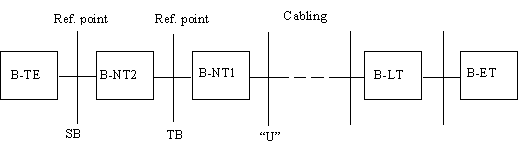
Figure 3: ISDN reference configuration
The I.432 series of Recommendations is applicable for both the Reference Points SB and TB. For a world-wide applicable standard for a UNI, it is necessary to clearly separate these reference points and identify at which reference point(s) a UNI specification applies. This separation is not always present, which can lead to ambiguity in the contractual relationship between customer and access network service provider.
For different Transport Modes (e.g. SDH, ATM), it is necessary to focus at which NT function e.g. the separation of the overhead from the payload has to be done. The termination of the OAM specific F-Flows, according to the ITU-T Recommendation I.610 [194] (F1 to F5-flows), at the predefined Reference Points should be clearly specified. For test purposes the missing distinction of the 2 Reference Points can lead to different Test-access and/or Test solutions. For new definitions the functional modelling method used in ETR326 (and widely applied for SDH in the ETS 300 417 series and for ATM in the DEN/TM-01016 series) is recommended to provide unambiguous specifications.
For wireless applications (e.g. RLL) the virtual Reference Points need individual definitions also. Non homogenous access networks (using e.g. xDSL technique within the network, with different bit rate transport support on individual transport links ), are another example where a precise specification of the BB-UNI is essential.
The two interfaces which attract currently most interest in the market for the provision of bi-directional broadband access (above 2 048 kbit/s) are Ethernet 10BaseT [168] and ATM 25 600 kbit/s according to I.432.5 [193]. At least in ETSI both interfaces are considered to apply at the SB reference point. Neither has been specified with the intent to support the contractual relationship and maintenance procedures that are normally associated with a UNI at the TB reference point. It is therefor a matter of some urgency that the standards bodies responsible for UNI specifications clarify the suitability of these interfaces as UNIs, specify enhancements where necessary and provide guidelines for their use.
| Recommendation 3: For a harmonious development of the market for broadband access a limited set of stable and well defined BB-UNI standards is essential. The standards bodies responsible for UNI specifications should clarify the suitability of the ATM 25 600 kbit/s and 10BaseT interfaces for this purpose, specify enhancements where necessary and provide guidelines for their use. |
5.4 An in-house analogue subscriber UNI specification
New technologies are used to provide in-house access to the telecommunications network:
- Fiber To The Home (FTTH).
- Radio Local Loop (RLL).
- Cable modem on cable TV network, etc.
All these technologies have the common feature that the analogue subscriber UNI is no more the interface from the local exchange deported by a copper wired line, but is supported by a stand alone unit at the customer's premises. Therefore, a new UNI specification should be created by the updating - through the deletion of the burden due to the wired line transmission - of the parameters of the currently used analogue subscriber UNI. This will significantly alter the following parameters of the UNI:
- Overvoltage protection.
- Line Impedance.
- Feed Bridge.
- Ringing Signal.
- Transmission characteristics.
A new standard should lead to a new set of values for these parameters, promoting then an harmonized European UNI for these ANs.
| Recommendation 4: WGs TM3 and TM4 of ETSI TM and EP ATA are encouraged to work in close co-operation on a new standard defining an analogue subscriber UNI dedicated to the ANs terminated by a stand alone unit at the customer's premises (FTTH, WLL, PSTN access through cable TV network, etc.), allowing more cost effective provisioning of these new technologies. |
5.5 The use of a technology independent reference point
Since the previous version of this report was published in November 1996 little progress has been made in the standards bodies on the specification of a TII (see clause 4.5.1.4). There are at least two reasons for this:
1) Network Operators have a strong preference to provide an active NT (Modem) on the customer premises with a well defined physically implemented UNI to ease quality control and maintenance of the AN.
2) Providers of Set Top Units have little commercial motivation to provide access to the internal interfaces in their equipment, as reflected by the decision of DVB to solely specify the external interfaces to the DVB STU.
The concept of a TII is nevertheless valuable, if not as a physical interface, then as a conceptual reference point for standardization purposes. It allows the decoupling of access network specific transmission termination functions from higher layer functions. It is also useful as a decoupling point between the specification of transmission termination and UNI termination function in a wired or wireless NT (modem). The latter concept is already used in xDSL standardization.
| Recommendation 5: AN standardization bodies are encouraged to identify a Technology Independent Reference Point in equipment related standards to facilitate the use of layer 1 technology specific standards in a modular fashion. |
5.6 Access to IP based networks
At present access to the Internet for residential subscribers is predominantly realized by:
a) Analogue subscriber UNI via Voiceband modem.
b) N-ISDN UNI via an ISDN PC-card.
In the near future we expect to see in addition significant use of:
c) 10BaseT "directly" over a PHY.
d) 10BaseT via ATM over a PHY.
e) ATM 25 600 kbit/s over a PHY.
d) Other ???.
The PHY may be implemented by ADSL, Cable modems or wireless means. Discussions in standards on the transmission convergence function for the PHY transmission techniques have been rather controversial. One extreme view is that the use of ATM is mandatory, the opposite view is that it is superfluous. This contradiction does not seem necessary. Technology would allow the option to have a flexible transmission convergence function that can be tailored to the service requirement.
| Recommendation 6: Standards should support a graceful evolution of the interface requirements of the customer. The option of a flexible transmission convergence function which can be optimized for the service requirement of the customer should be considered. |
5.7 Analysis of the different solutions for the AN architecture and the AN/SN interface
|
Type-of-AN/SN interface |
Definition |
Analysis |
| VB 5.1 | VB5.1 reference point between the Access network (AN) and the Service node (SN) provides flexible (provisioned) virtual path link (VPL) and flexible (provisioned) virtual channel link (VCL) allocation controlled by Management Q3 interfaces. | The AN equipment is kept simple and low cost.
VPC and VCC are established via Q3. RTMC protocol allows the AN to inform the SN on availability of the resources in real time. Standardized Q3 interface. Multivendor. |
| VB 5.2 | VB5.2 extends the capabilities at the VB5.1 reference point
to include on-demand connectivity in the AN under the control of SN via
real time control protocol B-BCC.
Call by call concentration |
Same as for VB 5.1 above.
Compatible with it. Optimization of AN resources on call by call basis. Addition of B-BCC protocol. ETSI standard in preparation. |
| Multiplexed UNI | Fixed multiplexing of UNI towards the SN (no concentration )
The AN may monitor signalling to detect call set up / release for charging purposes |
Charging in AN possible, but unreliable because of
signalling errors, the AN may lose information.
Need to keep customer data in AN. Need for X interface between AN and SN. Effort to upgrade SW with new Signalling versions. |
| UNI (Proxy- signalling in AN ) |
The AN contains a Proxy signalling for UNI protocol.
Call by call concentration. Able to charge in AN. |
More complex AN equipment SW part, but possible to put the
Proxy in a Call server. Processing throughput.
Charging in AN possible. Need to keep customer data in AN. Need for X interface with SN. Effort to upgrade SW with new UNI Signalling versions. |
| PNNI (AN as an ATM Switch ) |
AN able to terminate UNI signalling
Call by call concentration. PNNI between AN / SN. AN is a full ATM Switch. |
Most complex AN equipment. Processing throughput.
Local calls possible. Charging to AN customers. Need to keep customer data in AN. Need for full Management interface for AN and Switched services. Multivendor. Effort to upgrade SW with new UNI and PNNI Signalling versions. |
Conclusion
In summary, all solutions can be flexed to meet AN requirements, hence there is no recommendation for one particular type of interface.
The VB5 interfaces provide several attractive features, like simple and low cost, evolvable from VB5.1 to VB5.2 to allow optimization of the AN resources on a per call basis and support of multivendor arrangements. VB5 allows multiple SNs (but with multiple UNI Signalling channels from the Customer, one per SN). Management of VB5 is based on a standardized Q3 interface and therefore multivendor.
Other solutions based on UNI signalling or PNNI allow the AN Operator to charge the AN customers for AN services. Local AN calls are possible, as well as the on-demand selection of the SN. The call processing is limited by the processing throughput of the AN. On the other hand, the processing load on the SN could be decreased, by reducing the number of the signalling stack instances that need to be served by the SN. Signalling processing at the AN enables optimization of resources on a per call basis as well as support of multi-vendor arrangements. Management interfaces are more complex (Q3 or SNMP) to cover full AN and switched services
5.8 Access network management
Compared to other areas the progress that has been made over the last year in the field of access network management is rather modest. This may be due to the fact that management standards touch upon the operational practices of network operators, which they are hesitant to discuss. Interoperable access network management standards are however also in the self-interest of incumbent network operators, because they would facilitate:
- an operator of core and access networks to use different access network technologies,
- an operator of core and/or access networks to use different vendors for the same access network technology,
as well as:
- interoperability between different core network and access network operators.
Standardized information models do already exist for the core network. Similar technology independent information models are required for access networks to enable fruitful competition between technologies, vendors and operators.
| Recommendation 8: The access network management standardization groups are encouraged to enlist as much support as they can get from their members to accelerate the progress of this work. Priority should be given to standards that support interoperability between core and access network management in a technology independent way. |
5.9 Transport of timing information through access networks
The new proposals for hybrid AN configurations might imply a need to revise or develop new standards to support the timing distribution requirements for specific real time services.
For example, provision of real time services over HFC configurations might imply timing considerations on this new environment.
| Recommendation 9: The standardization groups with timing expertise (ETSI TM3 WPC and SG13/Q.18) are requested to provide guidance on the requirements for the transport of timing information through access networks for real-time audio and video services. |
5.10 Power requirements of access networks
New configurations such as cluster power feeding for street cabinets are foreseen. In this case the cluster power sources could be outside plant equipments.
This will require both remote management and new physical interfaces between the cluster power source and the AN management entity or other AN equipment respectively.
| Recommendation 10: Although powering of access networks is an AN internal concern, the cost benefits of harmonized requirements for power feeding of access networks warrant further study of this issue in ETSI EE2 and ITU-T SG15 and SG6. |
History
Document history |
||
| V1.2.1 | March 1998 | Membership Approval Procedure MV 9819: 1998-03-10 to 1998-05-08 |
| V1.2.1 | May 1998 | Publication |
Last updated: 2010-03-01 14:19:51