Specialist Task Force 300:
Character repertoires, ordering and assignments to the 12-key telephone
keypad - European languages and languages used in Europe
Who we are:
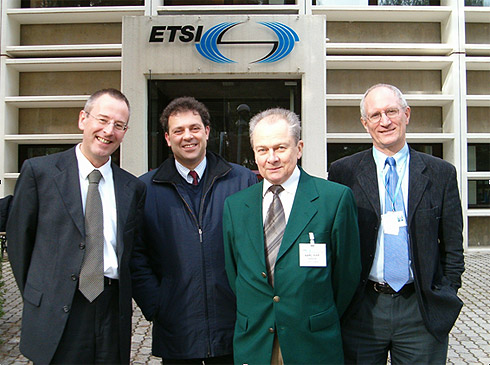
| Team Leader |
Bruno von Niman |
| Team Members |
Martin Böcker |
| Karl Ivar Larsson (February-October 2006) |
| ETSI Technical Officer |
Ted Laverack |
Latest News:
- A final review and consensus building Workshop has been held on
ETSI premises on Wednesday, May 16, 2007.
- The published ETSI Standard DES 202 130 (version 2.1.2) is
available here (click to
download).
Please contact Bruno von Niman:
bruno@vonniman.com or +46 733 66 1234
for any additional information!”
What we do :
We are co-funded by EC/EFTA to produce an expanded ETSI Standard (ES) on
Human Factors (HF): User Interfaces; Character repertoires, ordering and
assignments to the 12-key telephone keypad for European languages and other languages
used in Europe.
Scope of the work
This ETSI Standard will not cover user interface design and
implementation specific issues.
Read our
Terms of
Reference
Why we do it:
Devices with telecommunication
functionality represent the largest consumer product segment in the world.
Users must be provided with easy access to communication devices and services.
Easy, correct and efficient text input, search and retrieval via the telephone
keypad is a basic user requirement. Finding the characters necessary to enter a
name in the phonebook, search for a name, write an SMS message or log on to a
mobile Internet portal are most common, basic procedures. These cannot be easily
performed in a correct and consistent way, as different manufacturers apply
different character entry mapping and ordering. This varies sometimes even
between devices and applications coming from the same manufacturer!
Europe has approximately 230 indigenous languages - worldwide there are close to
7 000. The largest number of languages presently supported by a specific
telecommunications device or service is approaching 50. Cultural and linguistic
diversity is one of the key strengths of Europe. However, in ICT, it raises
issues that need to be considered and solved in order not to limit access to
services, their availability and usability, on the basic as well as more
advanced levels.
In order to be able to provide a technology-agnostic, consistent and
high-qualitative end user centric solution covering not only all official EU
languages but also minority languages and other languages used in Europe,
applicable to a variety of terminals with a 12-key keypad, an ETSI Specialist
Task Force has been established, to perform the work in close collaboration with
other stakeholders.
The previously developed ETSI Standard covering all official EU languages (ES
202 130) has received support from most manufacturers of mobile terminals.
Therefore, there is a very fair chance to quickly deploy such an extended
standard in product implementations, leading to harmonized access and an
improved user experience for many consumers.
The availability of and easy access to all characters used in European languages
is considered necessary, in order to enable proper access and cover most basic
user needs in the enlarged EU, with regard to our cultural diversity. This
benefits not only the consumer but also the society and its’ cultural diversity,
taking a step forward towards the achievement of the goals set by the European
Commission in the eEurope 2005 Action Plan and other, above mentioned documents.
The development currently performed takes into account work previously performed
in ETSI, ITU-T, CEN and ISO/IEC, adapting its results to be optimized for
devices and services used and accessed through the 12-key telephone keypad,
thereby focusing on telecommunication devices.
The deployment of the present document will enable users to reapply knowledge
and previous experience between different ICT devices and services using a
12-key standard keypad array and a display. Control of common functions such as
entering of characters and retrieval of text in a certain order will be
simplified.
Well-established services which rely on alpha mnemonics (e.g. "800 DOCTOR"
rather than "800 362867") will not be influenced as the present document only
complement the 12-key keypad standard specifying the assignment of A to Z to the
12-key keypad, see ETS 300 640.
The work is aligned with and partly funded through the European Commission’s
initiative eEurope 2005, a program for accelerated uptake and inclusive
deployment of new, important, consumer-oriented technologies. (http://europa.eu.int/information_society/eeurope).
How we do it
This activity will identify a common
assignment and access solution for European characters, complementing ES 202
130, covering all official EU languages.
The main output will be an updated version of ETSI Standard (ES) 202 130 version
1.1.1 covering major minority languages, additional
official European languages and other non-European languages used by a
considerable number of ICT users in Europe.
Details of our approach and language coverage are available
and presented in our draft, ETSI DES 202 130 version 2.1.1 (available below).
Time plan for the work (will be updated with additional details and public
Workshop dates):
| Milestones |
Work developent |
| February 2006 |
Start of Work |
| February - March 2006 |
Liaison activities started; first presentation to ISO/IEC, CEN and at HFT2006 |
| June 2006 |
Industry consensus building activities initiated |
| October 2006 |
Public consultation with NSOs and other bodies initiated |
| December 2006 |
Release of first stable draft ETSI Standard for public review and comments |
| January 2007 |
Industry Consensus building activities focused |
| February 2007 |
Release of stable draft ETSI Standard for public reviex and comments |
| May 16, 2007 |
Final review and consensus building workshop (ETSI Headquarters) |
| May 29, 2007 |
Release of final draft candidate ETSI Standard |
| June - August 2007 |
ETSI Membership Voting Procedure |
| September 2007 |
New ETSI Standard published and project closed |
Latest downloadable draft version, for comments:
The draft ETSI Standard DES 202 130 (Final
draft candidate) is available
here
(click to download).
This version of the
document has been submitted for the ETSI Membership Approval procedure
(voting open for 60 days).
We anticipate the publication of this ETSI Standard in August/September 2007
(matter of a favorable outcome).”
How to contact us:
To contact us, please email
info@vonniman.com.
We warmly welcome your comments!
Note: this information is based upon STF working assumptions.
The views expressed do not necessarily represent the position of ETSI in this
context.
Last updated: 2008-03-19 18:10:36